 Pradnya Ganorkar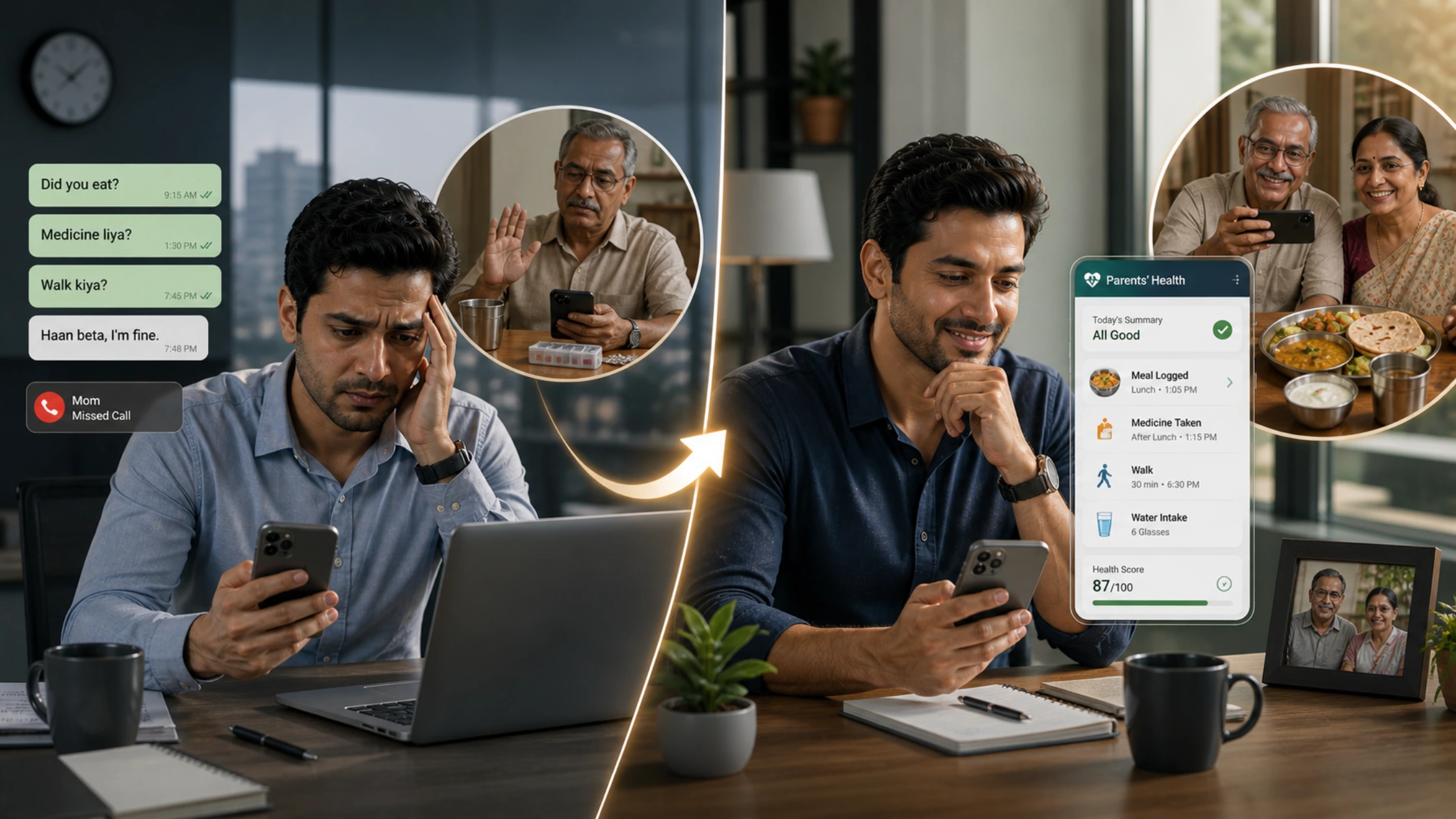
For millions of working adults, especially in India, one question quietly repeats every day:
“Did you eat?”
“Did you take your medicine?”
“Did you go for your walk?”
“How are you feeling?”
For many families, this is what health tracking for parents looks like.
Frequent calls.
Repeated reminders.
Constant concern.
And often, incomplete clarity.
This creates a painful emotional gap.
You care deeply.
But you still do not fully know what is happening.
This is one of the biggest modern family health challenges, especially for working professionals living away from parents.
Despite daily calls, many people still feel uncertain about:
- Diet consistency
- Medication patterns
- Energy changes
- Physical activity
- Emotional wellbeing
This uncertainty can increase both guilt and caregiver stress.
The issue is rarely lack of love.
It is lack of visibility.
This is why family health tracking app systems, caregiver health tools, and practical family wellness India frameworks are becoming increasingly important.
Not to replace care.
But to reduce guesswork.
Because the real goal is not constant questioning.
It is calmer awareness.
The “Did You Eat?” Problem
For many adult children, checking on parents often becomes repetitive.
Common Pattern:
- Morning call
- Food check
- Medicine reminder
- Evening follow-up
Emotional Reality:
You ask because you care.
But over time:
- Parents may feel monitored
- Children still feel unsure
- Conversations become functional
- Anxiety remains
Why This Happens:
Verbal updates are inconsistent.
Parents may say:
“Everything is fine.”
Even when:
- Meals were skipped
- Sugar was high
- Walk was missed
- Appetite was low
Core Problem:
Families rely heavily on memory and conversation.
Not systems.
Indian Family Context:
This challenge is amplified by:
- Children living in different cities
- Busy jobs
- Elderly parents underreporting issues
- Cultural reluctance to “burden” children
Practical Truth:
Calling often does not always equal clarity.
This is why many families begin exploring track parents diet systems and family nutrition habits India frameworks that reduce uncertainty.
Why Parents Don’t Share Health Details
Many parents intentionally minimize concerns.
Not because they are careless.
But because they often want to protect their children from worry.
Common Reasons:
1. Avoiding Concern
“I don’t want to disturb them.”
2. Normalizing Symptoms
“It’s just tiredness.”
3. Privacy
“I’m okay.”
4. Habitual Underreporting
Small changes feel unimportant.
The Risk:
Minor patterns may stay invisible until they become larger issues.
Examples:
- Lower appetite
- Poor hydration
- Reduced movement
- Medication inconsistency
- Blood sugar fluctuations
Emotional Layer:
This often increases caregiver stress because uncertainty feels harder than information.
Strategic Insight:
The problem is not communication alone.
It is data reliability.
Better Question:
How do families stay informed without making parents feel policed?
This is where health tracking for parents shifts from interrogation to passive visibility.
The Visibility Gap in Family Health
The biggest challenge in family caregiving is not always care itself.
It is visibility.
You May Know:
- Doctor appointments
- Major diagnoses
- Prescriptions
But Often Miss:
- Meal regularity
- Daily sugar habits
- Sleep shifts
- Low energy
- Routine decline
Why This Gap Matters:
Lifestyle decline is often gradual.
Example:
A parent may:
- Eat less protein
- Skip breakfast
- Walk less
- Sleep poorly
Each change alone may seem minor.
Together, they may indicate:
- Health decline
- Emotional stress
- Metabolic risk
Why Traditional Monitoring Falls Short:
Most families track crisis.
Few track patterns.
This is where:
- family health tracking app
- health tracking tools
- preventive health monitoring tools
Become more relevant.
Strategic Shift:
From:
“Is something wrong?”
To:
“How are daily patterns changing?”
What Actually Works: Passive Tracking
The best systems often reduce effort for everyone.
Passive Tracking Means:
Simple, low-friction awareness without constant questioning.
Goal:
Stay informed without creating pressure.
Examples:
- Meal logging
- Routine check-ins
- Medication patterns
- Step awareness
- Trend visibility
Why Passive Tracking Works:
It lowers:
- Emotional friction
- Parent resistance
- Repetitive calls
- Mental burden
Important:
This is not about surveillance.
It is about reducing uncertainty.
Practical Advantage:
Families can notice:
- Missed meals
- Repeated fatigue
- Sugar-heavy habits
- Declining routines
Earlier.
Productive Insight:
Some families now use simple daily logging to stay updated without constant calls.
This is where platforms like Nutrimate’s AI-powered, Indian-first, WhatsApp-first approach can support awareness through familiar behavior instead of overwhelming systems.
Core Principle:
Simple systems often improve consistency more than intense monitoring.
Simple Daily System for Families
A sustainable family system should feel supportive.
Not exhausting.
Step 1: Focus on Core Daily Markers
Track:
- Meals
- Medication
- Water
- Movement
- Energy
Step 2: Keep It Easy
Avoid complicated dashboards if they reduce adoption.
Step 3: Normalize Awareness
Health visibility should feel like care, not correction.
Step 4: Use Patterns
One missed meal is not the problem.
Repeated shifts matter more.
Step 5: Reduce Dependency on Memory
Systems outperform assumptions.
Family-Level Benefit:
This supports:
- Lower caregiver stress
- Better Indian family health habits
- Earlier intervention
- Better emotional balance
Real Example: Working Son/Daughter
Scenario:
Rohit, 33, Bangalore
Parents in Nagpur
Current Pattern:
- Daily calls
- Repeated reminders
- Frequent uncertainty
- Guilt when busy
Before:
Questions:
“Did you eat?”
“Medicine liya?”
Problem:
Information was inconsistent.
After:
Simple shared health awareness:
- Meal logging
- Medication visibility
- Basic routine trends
Result:
- Fewer anxious calls
- Better clarity
- More meaningful conversations
- Earlier awareness
Emotional Shift:
From guilt-driven checking
To calmer support
Do vs Don’t
DO:
- Build low-friction health tracking for parents
- Focus on trends
- Support without policing
- Prioritize visibility
- Use simple family health tracking app systems
- Reduce uncertainty gradually
DON’T:
- Constantly interrogate
- Assume “fine” means healthy
- Wait only for doctor visits
- Ignore routine decline
- Overcomplicate family health systems
Strategic Family Health Reality
Modern caregiving is changing.
The future is not:
“Ask more often”
It is:
“Know better with less friction”
This is especially true in India, where distance, busy work lives, and multi-generational care make traditional caregiving harder.
Better Family Health Means:
- Calm awareness
- Shared responsibility
- Early pattern recognition
- Lower emotional burnout
Practical Truth:
Better systems do not replace care.
They make care more sustainable.
Frequently Asked Questions
You can monitor your parents’ health remotely by focusing on simple daily visibility around meals, medication, movement, and routines through low-friction systems that reduce guesswork without creating constant pressure.
The best way to track elderly diet is through simple, sustainable awareness of meal regularity, food quality, hydration, and consistency rather than restrictive or overly complicated systems.
Reducing caregiver stress often starts with improving health visibility, simplifying communication, and creating reliable systems that reduce uncertainty instead of relying only on repeated reminders or reactive concern.