 Pradnya Ganorkar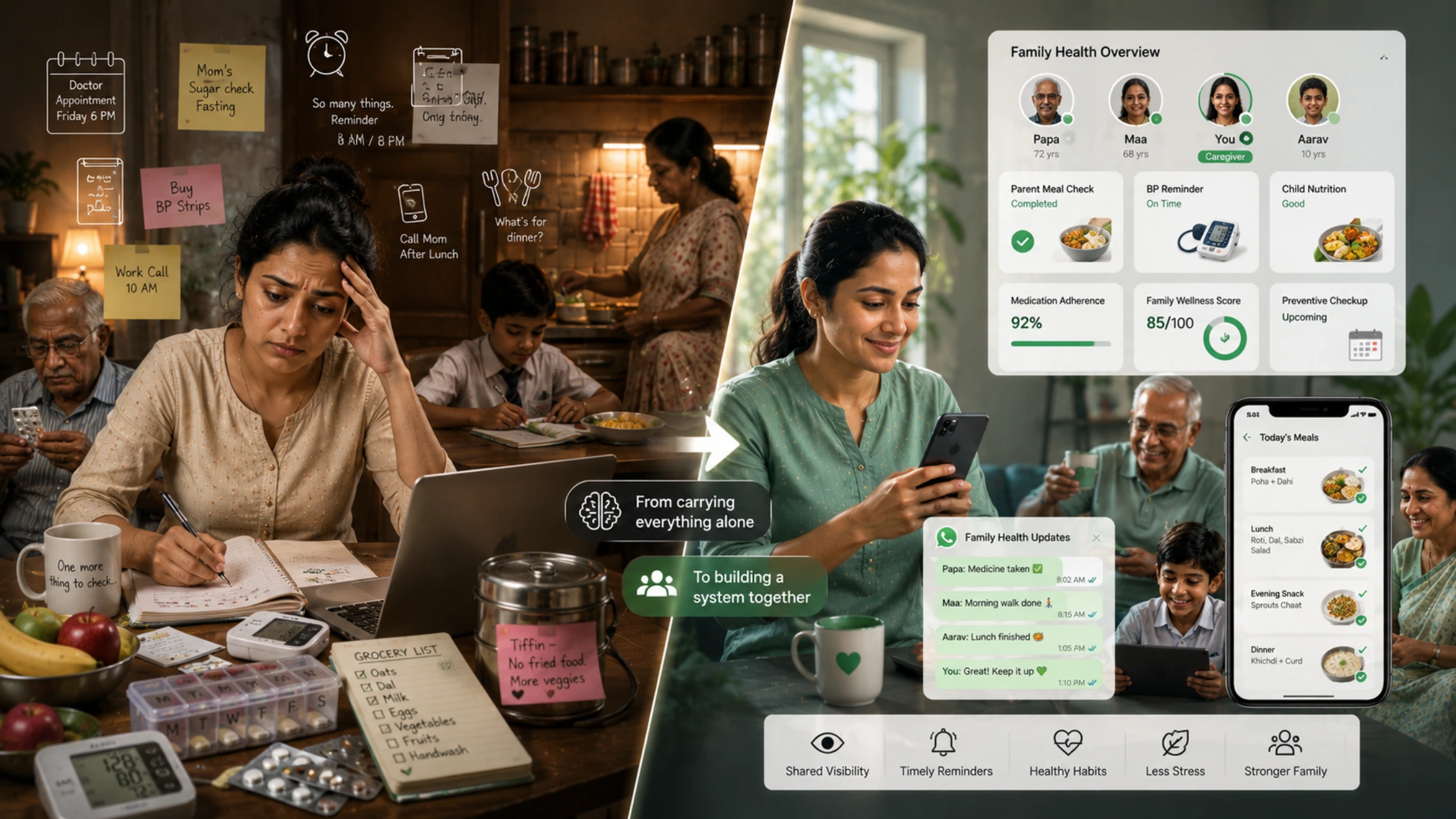
In many Indian homes, family health management India rarely feels like an official role.
There is usually no title.
No acknowledgment.
No salary.
No breaks.
Yet almost every family has one person quietly managing everyone’s health.
It may be:
A mother.
A daughter.
A wife.
A son.
A caregiver.
This person often tracks:
Medicines.
Doctor visits.
Parents’ sugar levels.
Children’s meals.
Household food.
Preventive checkups.
Health routines.
This invisible role shapes much of family preventive health India, but it often comes with exhaustion, emotional burden, and very little support.
For many families, the biggest challenge is not lack of care.
It is that family health responsibility becomes concentrated in one person’s mind.
And over time, this creates caregiver stress India often without families even realizing it.
This matters because health in Indian households is rarely just individual.
It is interconnected.
One person’s food choices affect the kitchen.
One person’s medicine schedule affects routines.
One elder’s diagnosis changes family priorities.
This is why household health planning and shared systems are becoming increasingly important.
Because in real life, family health is not just about treatment.
It is about sustainable coordination.
And increasingly, practical systems like India’s #1 whatsapp meal logging feature and Unique Caregiver feature reflect a growing need for centralized family visibility without adding more complexity to the person already carrying the load.
The Invisible Role Most Families Ignore
In Indian families, caregiving often becomes normalized so deeply that it becomes invisible.
The person remembering everyone’s:
- BP medicine
- Calcium tablets
- School nutrition
- Grocery balance
- Low-sugar meals
- Health reports
Is often treated as “just being responsible.”
But this is actually active family health management India.
Why This Role Is Overlooked:
Because it often happens quietly.
No one notices the constant:
- Reminder calls
- Meal adjustments
- Appointment scheduling
- Emotional monitoring
Common Indian Reality:
A working daughter may:
- Manage her job
- Track her father’s diabetes
- Monitor her mother’s diet
- Coordinate groceries
- Handle family doctor visits
Strategic Insight:
This invisible work is often operational healthcare.
Bottom Line:
Many households rely heavily on one person’s memory instead of a shared health system.
That creates fragility.
Why Family Health Responsibility Falls on One Person
This pattern is not accidental.
It is cultural, behavioral, and structural.
Common Reasons:
1. Traditional Family Roles
In many Indian households, women often carry disproportionate household health habits India responsibilities.
2. Information Asymmetry
One person often becomes “the organized one,” so all health logistics shift to them.
3. Emotional Reliability
Families naturally depend on the person most likely to remember details.
4. Lack of Systems
Without centralized tracking, responsibility defaults to one human brain.
Myth vs Reality:
Myth: Families share health responsibility equally.
Reality: In many homes, one person becomes the default manager.
Emotional Cost:
This can create:
- Burnout
- Anxiety
- Resentment
- Missed self-care
Key Insight:
The issue is often not family neglect.
It is system absence.
The Mental Load of Managing Everyone
Caregiver burnout India is not always physical exhaustion.
Often, it is cognitive overload.
What Is Caregiver Mental Load?
The constant mental burden of anticipating, remembering, and coordinating health needs for others.
Examples:
- Did dad take insulin?
- Did mom reduce salt?
- Did child eat protein?
- When is next blood test?
- Are medicines running low?
Why This Becomes Dangerous:
Mental overload can lead to:
- Forgotten checkups
- Emotional fatigue
- Personal burnout
- Health blind spots
Indian Family Reality:
Many caregivers prioritize:
“Everyone else first.”
Their own healthy lifestyle often declines.
Strategic Problem:
A family may appear functional while one person is silently overwhelmed.
Bottom Line:
Caregiver burden is often hidden because competence masks exhaustion.
Common Health Gaps Families Miss
Even loving families often miss patterns because health is tracked reactively, not proactively.
Common Gaps:
Nutrition Drift
Daily tea sugar.
Fried snacks.
Late dinners.
Low protein.
Preventive Blind Spots
Missed:
- BP checks
- HbA1c
- Vitamin D
- Sleep decline
Elderly Health Oversight
Parents may say:
“I’m fine.”
But without parents health tracking, patterns can stay invisible.
Children’s Nutrition Assumptions
“Eating enough” is not the same as balanced eating.
Family-Wide Problem:
Many families focus on illness response rather than family nutrition planning India.
Key Insight:
Health problems often grow quietly through routine, not crisis.
How to Build a Shared Health System
The solution is not forcing one person to do more.
It is reducing invisible complexity.
Step 1: Centralize Key Information
Track:
- Medicines
- Meals
- Checkups
- Conditions
- Daily patterns
Step 2: Simplify Family Participation
Not everyone needs deep tracking.
But everyone should have basic awareness.
Step 3: Focus on Habit Visibility
Simple indicators:
- Meal regularity
- Sugar intake
- Activity
- Medication adherence
Step 4: Reduce Memory Dependency
Health systems should not rely entirely on one person’s mental load.
Step 5: Build Shared Accountability
Examples:
- Shared grocery logic
- Parent check-in routines
- Family meal awareness
Practical Opportunity:
Tools designed around family health tracking app behavior can help reduce caregiver overload by making health easier to monitor collectively.
Nutrimate Context:
This is where Nutrimate’s Indian-first approach supports practical consistency by simplifying meal and habit awareness within real Indian households.
Real-Life Example: Working Daughter / Mother
Scenario:
Priya, 34, Pune.
Works full-time.
Lives with parents.
Married with one child.
Her Invisible Daily Health Tasks:
- Mother’s thyroid meds
- Father’s diabetic meals
- Child lunchbox
- Grocery planning
- Weekend tests
Problem:
Everything depends on Priya remembering.
Emotional Outcome:
- Constant stress
- Self-neglect
- Mental fatigue
Better Model:
A centralized health habit system.
Result:
- Better visibility
- Less pressure
- Shared family awareness
- Reduced cognitive burden
Lesson:
The issue was not lack of love.
It was unsustainable structure.
Do vs Don’t
DO:
- Build shared systems
- Simplify household routines
- Track patterns, not perfection
- Support the caregiver
- Prioritize preventive consistency
DON’T:
- Assume one person can remember everything
- Wait for illness before acting
- Ignore caregiver fatigue
- Depend only on verbal reminders
- Treat health management as invisible labor
Strategic Insight:
The healthiest families are often not the strictest.
They are the most aware.
Final Reality:
When one person quietly manages all family health, the system may function.
But it may not be sustainable.
Better family health management India means shifting from:
One-person burden
To:
Shared health infrastructure
Because healthier families are not built only on care.
They are built on visibility, systems, and support.
FAQs
In many Indian households, family health responsibility often falls on one person due to traditional caregiving roles, better organization, emotional reliability, and lack of centralized systems. This creates invisible mental and operational burden over time.
Better family health management involves building shared systems for meal awareness, medication tracking, preventive checkups, and daily habit visibility so responsibility is distributed rather than carried by one person alone.
Caregiver mental load is the ongoing cognitive and emotional burden of remembering, planning, and managing health-related responsibilities for family members, often without formal support or recognition.