 Pradnya Ganorkar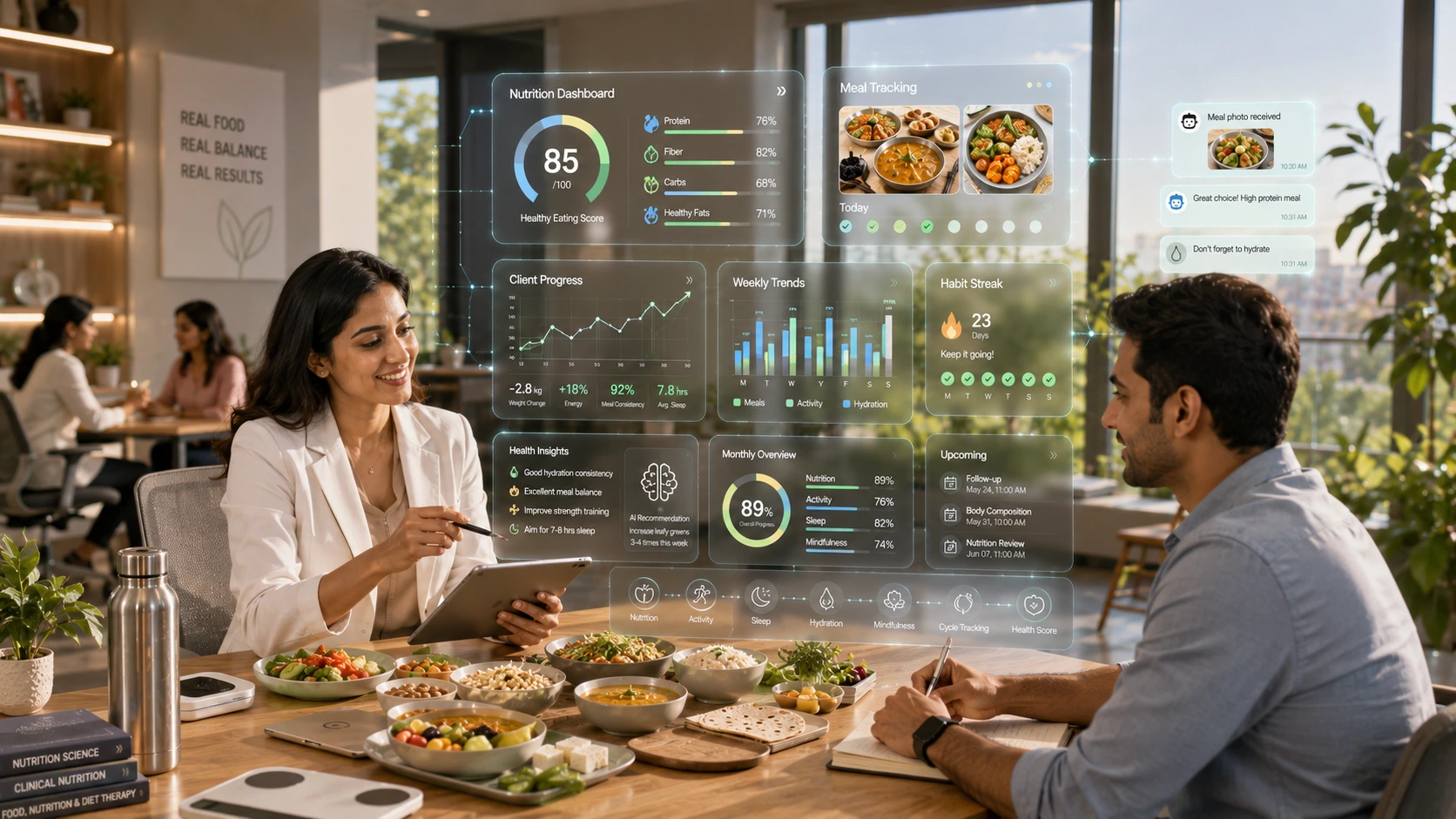
India’s nutrition industry is growing rapidly. Rising awareness of lifestyle diseases, preventive healthcare, fitness, and personalized nutrition has created significant opportunities for qualified nutritionists and dietitians. However, while demand is increasing, building a successful nutrition practice management system requires much more than nutritional expertise.
Many professionals enter the field with strong clinical knowledge but struggle with nutritionist practice growth because managing appointments, following up with clients, tracking progress, handling payments, maintaining engagement, and delivering personalized care quickly become operational challenges.
Today’s clients also expect convenience. They want online nutrition coaching, digital communication, personalized meal guidance, progress visibility, and continuous support rather than a single consultation every few weeks. As a result, effective nutrition practice software, structured workflows, and consistent client engagement have become essential for long-term success.
Technology should not replace the nutritionist. Instead, it should simplify repetitive tasks, improve client adherence, and create more time for meaningful coaching. Modern platforms such as Nutrimate demonstrate how AI-supported nutrition tracking software and India’s #1 WhatsApp meal logging feature and Unique Caregiver feature can reduce manual effort while helping nutrition professionals maintain better visibility into client habits.
Whether you are an independent nutritionist, operate a clinic, offer virtual consultations, or are planning to expand your nutrition coaching business, building scalable systems is now just as important as designing effective meal plans.
Why this topic matters today
The Indian healthcare landscape is shifting from treating illness to preventing it.
Increasing cases of obesity, diabetes, hypertension, PCOS, thyroid disorders, and cardiovascular diseases have made preventive healthcare and personalized nutrition more relevant than ever before.
At the same time, client expectations have changed significantly.
Today’s clients expect:
- Personalized nutrition recommendations
- Convenient digital communication
- Faster responses
- Continuous accountability
- Progress reports
- Easy meal tracking
- Flexible virtual consultations
This evolution has accelerated demand for modern nutrition consultation software, nutrition coaching platform solutions, and better nutrition practice systems.
Traditional paper files, spreadsheets, and WhatsApp conversations alone are no longer sufficient for managing dozens or hundreds of active clients efficiently.
Nutrition businesses are becoming service ecosystems
Successful practices are no longer limited to one-on-one consultations.
Many Indian nutritionists now offer:
- Monthly coaching programs
- Family nutrition plans
- Corporate wellness services
- Weight management programs
- Diabetes nutrition support
- PCOS coaching
- Sports nutrition
- Child nutrition
- Online consultations
- Subscription-based coaching
Managing these services requires organized nutrition workflow, standardized documentation, and efficient client management for nutritionists.
Without structured systems, administrative work often consumes more time than actual coaching.
Biggest challenges professionals face
Many nutritionists assume acquiring new clients is their biggest challenge.
In reality, retaining clients and delivering consistent experiences usually has a much greater impact on long-term growth.
1. Poor client adherence
One of the biggest challenges in nutrition coaching is that clients often stop following recommendations after the initial enthusiasm fades.
Common reasons include:
- Busy work schedules
- Forgetting to log meals
- Low accountability
- Family commitments
- Travel
- Lack of motivation
This makes client adherence nutrition one of the most important success factors for any nutrition practice.
Helping clients stay engaged consistently usually delivers better outcomes than creating increasingly complex diet plans.
2. Administrative overload
Many practitioners spend hours each week:
- Scheduling appointments
- Sending reminders
- Reviewing food diaries
- Updating spreadsheets
- Preparing reports
- Answering repetitive questions
- Managing payments
These repetitive tasks reduce the time available for personalized coaching.
This is where organized nutrition automation, structured nutrition CRM, and nutrition reporting software become valuable operational assets.
3. Difficulty tracking real-world eating habits
Indian eating habits are highly diverse.
Clients may consume:
- Home-cooked meals
- Regional cuisines
- Street food
- Restaurant meals
- Festival foods
- Packaged snacks
Manual food logging often becomes inconsistent because entering every ingredient is time-consuming.
This reduces data accuracy and makes it harder for nutritionists to understand actual dietary behaviour.
Instead of relying entirely on memory during consultations, continuous visibility into eating habits supports more informed recommendations.
4. Limited client engagement between consultations
Many nutrition practices still operate using a simple cycle:
Consultation → Meal Plan → Next Appointment
Unfortunately, this creates long periods with little interaction.
Without regular engagement, clients may:
- Lose motivation
- Stop following meal plans
- Forget recommendations
- Delay appointments
- Eventually discontinue coaching
Improving nutrition client engagement requires simple, sustainable touchpoints rather than constant communication.
Examples include:
- Weekly progress reviews
- Habit reminders
- Meal logging
- Monthly reports
- Small behavioural goals
- Educational content
5. Scaling without losing personalization
As practices grow, maintaining high-quality personalized care becomes increasingly difficult.
Managing 20 clients manually is possible.
Managing 200 requires structured dietitian practice management, standardized workflows, and digital systems that reduce administrative burden while preserving individual attention.
This is why many successful practices now invest in nutritionist software India, dietitian software, and integrated nutrition coaching software that centralize consultations, client records, communication, and progress monitoring.
Rather than replacing the nutrition professional, these tools support better decision-making by organizing information in one place.
For nutritionists working alongside fitness professionals, integrated ecosystems are becoming increasingly valuable. For example, FitVia complements Nutrimate by helping gyms, fitness coaches, and dietitians manage client engagement, nutrition tracking, workout planning, and progress reporting through one connected platform. This creates smoother collaboration while allowing each professional to focus on delivering better client outcomes rather than administrative work.
Step-by-step implementation framework
Building a successful nutrition practice management system is not about working longer hours. It is about creating repeatable processes that improve client outcomes while allowing your practice to grow sustainably.
The following framework can help nutritionists, dietitians, and wellness professionals build an efficient and scalable practice.
Step 1: Define your ideal client
Many practitioners try to serve everyone.
Instead, specialize around one or two primary client groups, such as:
- Weight management
- PCOS
- Diabetes
- Sports nutrition
- Child nutrition
- Women’s health
- Senior nutrition
- Corporate wellness
A clear niche strengthens your positioning, improves referrals, and supports nutrition business growth.
Step 2: Standardize your consultation process
Every client should experience a structured journey.
For example:
| Stage | Objective |
| Discovery Call | Understand goals and expectations |
| Assessment | Review medical history, lifestyle, eating habits, and activity |
| Nutrition Plan | Develop personalized recommendations |
| Weekly Review | Evaluate adherence and adjust plans |
| Monthly Progress | Measure outcomes and reinforce motivation |
A standardized workflow improves quality while reducing unnecessary manual effort.
Step 3: Focus on behaviour before perfection
Many nutrition plans fail because they emphasize perfect eating instead of sustainable routines.
Encourage clients to develop simple habits like:
- Eating protein with every meal
- Drinking enough water
- Walking after meals
- Planning meals ahead
- Sleeping consistently
- Logging meals daily
These small changes drive lasting behavior change and improve client retention more effectively than restrictive diets.
Step 4: Improve visibility through consistent tracking
Clients often underestimate what they eat or forget important details between consultations.
Regular meal tracking, client progress tracking, and habit monitoring provide objective information that supports better nutritional decisions.
Rather than relying only on memory, nutrition professionals can identify:
- Skipped meals
- Frequent snacking
- Weekend eating patterns
- Low protein intake
- Poor hydration
- Irregular meal timings
Platforms like Nutrimate simplify this process through AI-powered Indian meal recognition and India’s #1 WhatsApp meal logging feature and Unique Caregiver feature, making tracking easier without adding unnecessary complexity.
Step 5: Automate repetitive tasks
Automation does not replace personal coaching.
It removes repetitive administrative work.
Examples include:
- Appointment reminders
- Follow-up messages
- Progress reports
- Meal logging reminders
- Consultation scheduling
- Client feedback collection
A structured nutrition workflow supported by nutrition automation allows practitioners to spend more time delivering value.
Common mistakes to avoid
Even experienced nutritionists often face operational challenges that limit growth.
Avoid these common mistakes.
Trying to manage everything manually
Using spreadsheets, handwritten notes, and multiple messaging apps may work initially but becomes inefficient as the client base grows.
Investing in reliable nutrition practice software improves organization and reduces administrative burden.
Overcomplicating nutrition advice
Clients rarely fail because they lack information.
They struggle because recommendations are difficult to maintain.
Simple guidance, realistic goals, and gradual improvements encourage better adherence.
Ignoring follow-up
The consultation is only the beginning.
Consistent follow-up strengthens accountability and supports long-term client adherence nutrition.
Measuring only weight
Body weight is just one health indicator.
Also monitor:
- Eating habits
- Energy levels
- Sleep quality
- Activity
- Waist measurements
- Clinical markers where appropriate
- Habit consistency
This creates a more complete picture of progress.
Not investing in digital systems
Modern clients expect convenient communication, virtual consultations, and accessible progress tracking.
Digital systems improve both client satisfaction and operational efficiency.
Tools, systems or workflows
A modern digital nutrition practice combines professional expertise with organized systems.
An effective workflow may include:
| Practice Area | Recommended System |
| Client onboarding | Digital intake forms |
| Consultations | Virtual nutrition consultation platform |
| Meal logging | Nutrition tracking software |
| Progress reviews | Nutrition analytics dashboards |
| Reporting | Nutrition reporting software |
| Follow-ups | Automated reminders |
| Client communication | Secure messaging |
| Documentation | Centralized client records |
This structured approach supports better nutrition clinic management, reduces missed follow-ups, and improves overall coaching quality.
For professionals working with gyms or fitness businesses, connected platforms can further simplify operations. FitVia, for example, complements nutrition practices by helping trainers, dietitians, and gym owners manage workout planning, client engagement, nutrition monitoring, and progress reporting through a unified ecosystem. This collaborative approach helps improve coaching consistency without increasing administrative workload.
Future trends
The future of nutrition practice management is moving beyond one-time consultations toward continuous engagement, preventive care, and data-informed coaching.
Several trends are already shaping the next generation of nutrition practices in India.
1. Hybrid coaching models
Clients increasingly expect a combination of in-person and virtual care. Online nutrition coaching supported by periodic clinic visits allows nutritionists to serve more clients while maintaining personalized care.
2. AI-assisted nutrition support
Artificial intelligence is becoming a practical assistant rather than a replacement for nutrition professionals. AI can help organize meal logs, identify nutrition patterns, and reduce manual documentation, allowing practitioners to focus on coaching and clinical decisions.
3. Greater focus on preventive healthcare
More organizations, families, and individuals are investing in preventive healthcare instead of waiting for chronic conditions to develop. This creates opportunities for nutritionists to work with corporate wellness programs, preventive health clinics, and long-term lifestyle management initiatives.
4. Better client engagement through digital tools
Successful practices will increasingly rely on nutrition coaching tools, nutrition tracking software, and client progress tracking instead of depending only on periodic consultations.
The goal is continuous visibility rather than occasional interaction.
5. Connected wellness ecosystems
Nutrition is becoming closely linked with fitness, sleep, mental wellbeing, and health monitoring. Practices that integrate these services will deliver greater long-term value while improving client retention and overall health outcomes.
Key takeaways & checklist
Building a successful nutrition practice is no longer just about providing accurate meal plans.
It requires structured systems, consistent client engagement, and scalable workflows.
Use this checklist to evaluate your practice:
✔ Define a clear niche and target audience.
✔ Standardize your consultation and follow-up process.
✔ Focus on sustainable habits instead of restrictive diets.
✔ Improve nutrition client engagement through regular communication.
✔ Track behaviours, not just body weight.
✔ Use reliable nutrition consultation software and nutrition CRM to reduce administrative work.
✔ Measure outcomes using nutrition analytics and progress reports.
✔ Continue educating clients to improve long-term adherence.
For practices aiming to scale, simple technology can make a meaningful difference. Nutrimate supports nutrition professionals by improving visibility into client habits through AI-powered Indian meal recognition and India’s #1 WhatsApp meal logging feature and Unique Caregiver feature. Rather than replacing expert guidance, it helps nutritionists spend less time collecting information and more time delivering personalized coaching.
FAQs
The most effective approach combines evidence-based nutrition with structured workflows, regular client engagement, and consistent habit tracking. Building repeatable systems improves both client outcomes and operational efficiency.
Nutritionists should use secure nutrition practice software, nutrition tracking software, digital consultation platforms, reporting tools, and client management systems that simplify scheduling, documentation, follow-ups, and progress tracking.
Retention improves when clients receive continuous support rather than one-time consultations. Regular follow-ups, personalized recommendations, habit tracking, measurable progress reports, and ongoing communication help clients stay motivated and engaged.
Avoid relying entirely on manual processes, overcomplicating nutrition advice, measuring only weight, neglecting follow-ups, and delaying investment in organized digital systems. Sustainable practice growth comes from combining expert nutrition guidance with efficient workflows.