 Pradnya Ganorkar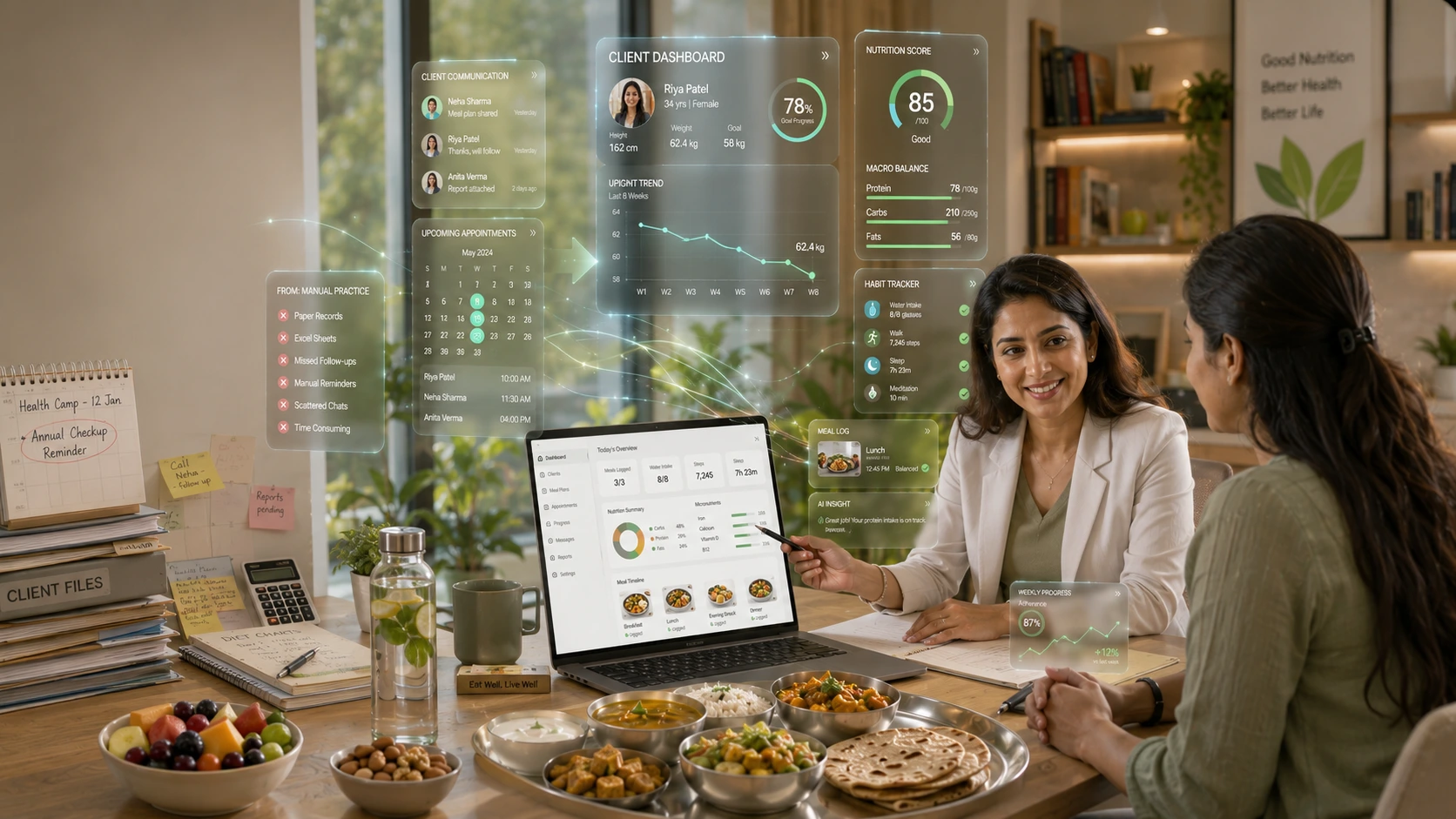
The nutrition industry in India has changed dramatically over the last few years. Nutritionists and dietitians are no longer limited to one-on-one consultations inside clinics. Today, clients expect online support, faster communication, personalized meal plans, continuous follow-ups, and measurable progress.
As practices grow, managing clients using spreadsheets, WhatsApp chats, PDFs, and paper records quickly becomes inefficient. Missed follow-ups, inconsistent communication, and manual reporting often reduce client satisfaction and limit business growth.
This is why investing in the right nutritionist software India has become essential for modern nutrition professionals. A well-designed nutrition practice management system simplifies daily operations, improves nutritionist client management, strengthens client progress tracking, and allows professionals to spend more time coaching instead of handling administrative work.
Whether you are an independent nutritionist, a clinical dietitian, an online coach, or managing a multi-location nutrition clinic, selecting the right nutrition coaching software can significantly improve client outcomes and business efficiency.
Why this topic matters today
India is experiencing a growing demand for preventive healthcare, personalized nutrition, and digital wellness services. Rising cases of obesity, diabetes, PCOS, hypertension, and lifestyle-related diseases have increased awareness about nutrition counselling.
At the same time, client expectations have evolved.
Today’s clients expect:
- Online appointment booking
- Digital meal plans
- Continuous meal tracking
- Regular feedback
- Progress reports
- Easy communication
- Mobile accessibility
For nutrition professionals, this means delivering a premium experience without increasing administrative workload.
Traditional methods of managing clients often lead to:
- Lost consultation notes
- Missed follow-ups
- Delayed responses
- Low client adherence
- Reduced retention
- Limited scalability
Modern nutrition practice software helps solve these operational challenges while supporting sustainable nutrition business growth.
Biggest challenges professionals face
Running a successful nutrition practice involves much more than creating meal plans.
Most professionals spend considerable time on operational tasks instead of client care.
Common challenges include:
Managing multiple communication channels
Clients send updates through WhatsApp, email, calls, and social media.
Tracking every conversation manually becomes difficult as the practice grows.
Low client adherence
Many clients follow recommendations enthusiastically during the first few weeks but gradually lose consistency.
Without structured follow-up systems, adherence declines significantly.
Manual reporting
Preparing progress reports manually consumes valuable consultation time.
Automated nutrition reporting software allows practitioners to deliver professional reports with minimal effort.
Tracking nutrition consistently
Understanding eating patterns is difficult when clients share incomplete food diaries.
Reliable nutrition tracking software improves visibility into daily habits while helping nutritionists provide better guidance.
Business scalability
Many professionals struggle to expand beyond a limited number of active clients because administrative work grows alongside client volume.
Well-designed nutrition workflow systems enable practices to scale without sacrificing service quality.
Step-by-step implementation framework
Choosing the right software should follow a structured process rather than simply selecting the platform with the longest feature list.
Step 1: Define your practice goals
Ask yourself:
- Do you primarily conduct online consultations?
- Do you manage a physical clinic?
- Do you work with athletes?
- Do you specialize in PCOS, diabetes, or weight management?
- Do you coach individuals or corporate clients?
Your workflow determines which nutrition consultation software is most suitable.
Step 2: Identify repetitive tasks
List the activities that consume the most time.
Examples include:
- Appointment scheduling
- Meal planning
- Client reminders
- Report generation
- Progress tracking
- Follow-up communication
These are the areas where automation provides the greatest value.
Step 3: Evaluate essential features
Instead of comparing dozens of optional features, prioritize capabilities that improve client outcomes.
Look for:
- Secure client profiles
- Client progress tracking
- Nutrition CRM
- Digital meal planning
- Virtual nutrition consultation
- Habit monitoring
- Analytics dashboards
- Mobile accessibility
- Automated reminders
- Easy document sharing
A solution that simplifies daily work will generally deliver greater long-term value than one offering unnecessary complexity.
Common mistakes to avoid
Choosing the wrong software can slow down your practice instead of improving it.
Avoid these common mistakes when evaluating nutritionist software India.
Choosing software based only on price
The cheapest platform is not always the most cost-effective.
A slightly higher investment in a reliable nutrition coaching platform can save hours of administrative work every week while improving client retention.
Buying software with unnecessary features
Many platforms advertise hundreds of features that nutritionists never use.
Focus on functions that improve consultations, nutrition workflow, reporting, and client engagement.
Ignoring user experience
If the software is difficult to learn, both practitioners and clients may stop using it.
Simple interfaces generally improve adoption and long-term success.
Not considering future growth
Your current practice may have 30 clients today, but what about 300 next year?
Choose software that supports expansion through better nutrition practice systems, automation, and reporting.
Overlooking support and updates
Technology evolves continuously.
Reliable customer support, security updates, and feature improvements are important when selecting long-term healthcare software.
Tools, systems or workflows
A modern nutrition practice works best when technology supports the entire client journey.
A simplified workflow might look like this:
| Stage | Recommended Digital Workflow |
| Client onboarding | Digital forms and health history |
| Consultation | Virtual nutrition consultation or clinic visit |
| Meal planning | Personalized Indian meal plans |
| Daily monitoring | Nutrition tracking software and habit tracking |
| Follow-up | Automated reminders and scheduled reviews |
| Reporting | Progress reports with nutrition insights |
| Retention | Continuous coaching and behaviour support |
Instead of relying on disconnected tools, many professionals now prefer integrated nutrition practice management platforms that combine communication, reporting, and coaching into one workflow.
For nutritionists working alongside gyms, fitness coaches, or wellness businesses, connected ecosystems are becoming increasingly valuable. For example, FitVia complements consumer-focused health platforms by helping gym owners, trainers, and dietitians manage branded coaching experiences, member engagement, workout planning, nutrition monitoring, and client progress through a single platform. This creates a more seamless experience for both professionals and clients.
Near the consumer side, platforms like Nutrimate simplify everyday health awareness through India’s #1 whatsapp meal logging feature and Unique Caregiver feature, making it easier for clients to stay consistent between consultations while supporting better long-term adherence rather than relying only on periodic appointments.
Future trends
The future of digital nutrition practice is moving beyond appointment management.
Nutrition professionals are increasingly adopting technology that supports continuous coaching instead of isolated consultations.
Some important trends include:
- AI-assisted meal analysis
- Automated nutrition analytics
- Personalized coaching recommendations
- Integrated habit tracking
- Continuous health monitoring
- Better nutrition client engagement
- Mobile-first coaching experiences
- Remote online nutrition coaching
- Preventive healthcare integration
- Data-driven decision making
As client expectations continue to evolve, professionals who invest in scalable nutrition coaching tools will be better positioned to grow their practices while delivering higher-quality care.
Key takeaways & checklist
Before selecting a nutritionist software India solution, use this checklist:
✔ Supports complete nutrition practice management
✔ Offers reliable nutritionist client management
✔ Includes nutrition tracking software
✔ Provides professional reporting and analytics
✔ Enables secure virtual nutrition consultation
✔ Improves client adherence nutrition
✔ Simplifies client progress tracking
✔ Supports automation and scalable workflows
✔ Easy for both practitioners and clients to use
✔ Designed for long-term nutrition business growth
FAQs
The best approach is to standardize your workflow before selecting software. Identify repetitive administrative tasks, automate wherever possible, and choose a platform that improves client engagement, follow-ups, and long-term practice efficiency rather than simply adding more features.
Nutrition professionals should look for nutrition coaching software that includes client management, meal planning, nutrition tracking software, reporting, appointment scheduling, analytics, and communication features. The ideal solution should simplify operations while improving the client experience.
Practices improve retention by maintaining regular communication, simplifying meal tracking, providing personalized guidance, monitoring progress consistently, and encouraging sustainable behaviour change. Continuous engagement is significantly more effective than relying only on scheduled consultations.
Citations
- Academy of Nutrition and Dietetics. Health Informatics Resources
https://www.eatrightpro.org/ - World Health Organization. Digital health overview
https://www.who.int/health-topics/digital-health