 Pradnya Ganorkar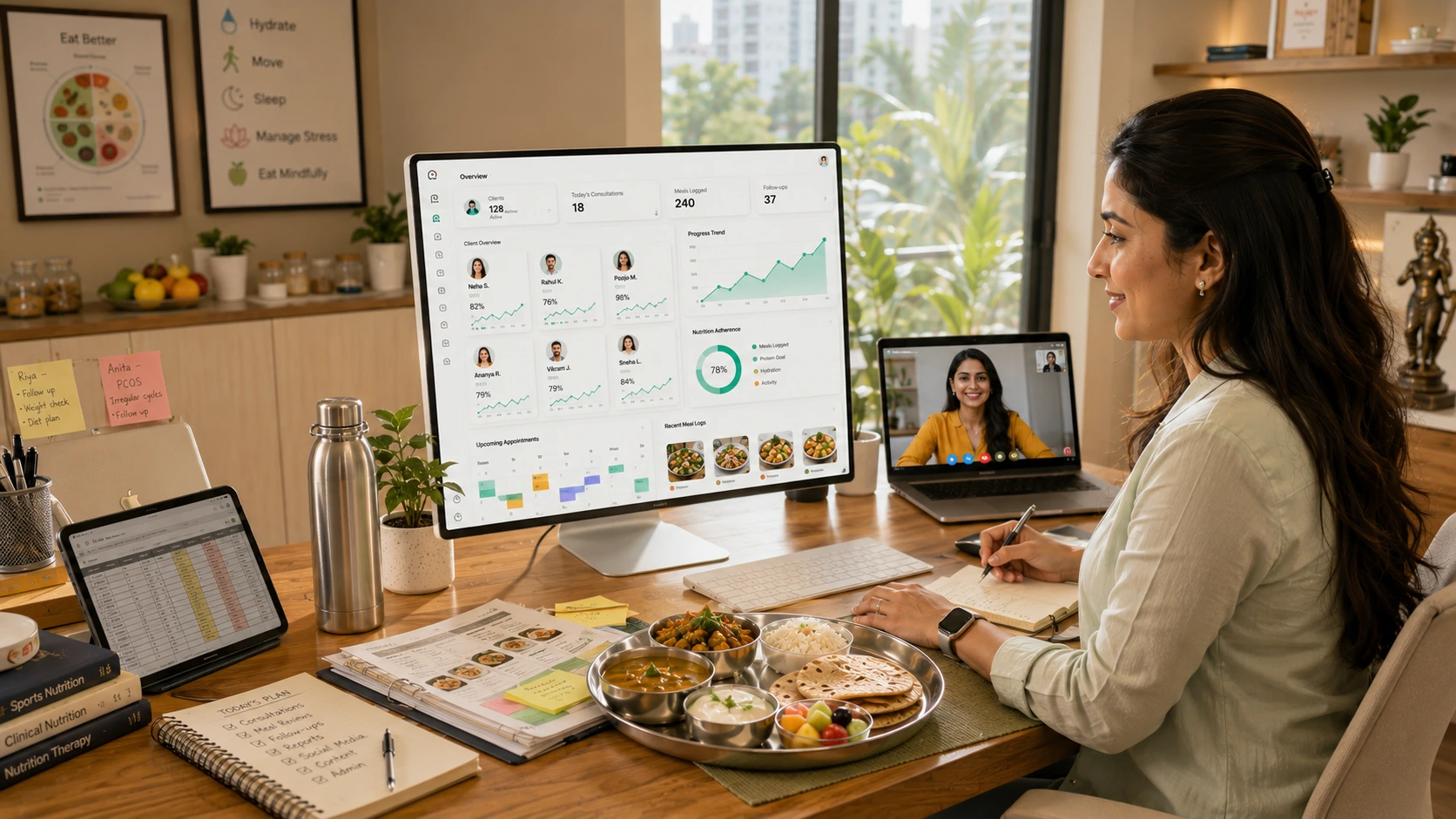
A dietitian may start with 10 clients, manage appointments through phone calls, collect meal updates on WhatsApp, prepare plans manually, and track progress using spreadsheets. The system works until the practice begins to grow.
At 30, 50, or 100 clients, the same process becomes difficult to manage.
This is one of the biggest operational challenges facing online nutrition coaching in India. Growing a practice is no longer only about attracting more clients. Dietitians need better nutrition practice management, consistent client engagement, structured follow-ups, and enough visibility to understand whether clients are actually following their plans.
For modern nutrition professionals, the real question is not simply how to deliver consultations online. It is how to build a scalable system that maintains personalisation, accountability, and quality as the practice grows.
Why this topic matters today
The way people access nutrition guidance is changing.
A client in Pune can consult a dietitian in Bengaluru. An Indian professional working in Dubai can receive culturally relevant guidance from a nutritionist in India. Working parents can attend consultations without travelling to a clinic.
This flexibility has expanded opportunities for digital nutrition coaching and virtual nutrition consultation.
However, moving consultations online does not automatically create a scalable practice.
Many professionals simply transfer their offline processes to video calls and WhatsApp. Consultations become virtual, but the underlying nutrition workflow remains manual.
A growing digital nutrition practice may involve:
- Scheduling consultations.
- Collecting health and lifestyle information.
- Creating personalised meal plans.
- Monitoring meal tracking.
- Reviewing progress.
- Answering client questions.
- Sending reminders.
- Updating recommendations.
- Preparing reports.
- Managing payments and renewals.
Without structured nutrition practice systems, administrative work increases with every new client.
The goal of technology should therefore be simple: reduce operational friction so nutrition professionals can spend more time on meaningful nutrition coaching and less time managing scattered information.
Biggest challenges professionals face
The biggest barrier to scaling a nutrition practice is rarely a lack of nutrition knowledge. It is the difficulty of managing more clients without reducing service quality.
Fragmented client information
A client’s consultation notes may be stored in one document, meal photos in WhatsApp, weight records in a spreadsheet, and progress reports somewhere else.
Without effective nutritionist client management, reviewing a client’s complete journey becomes time-consuming.
This fragmentation also makes client progress tracking difficult. A dietitian may know what advice was given but lack visibility into what happened between consultations.
Poor client adherence
Clients often begin with high motivation.
They follow their meal plan carefully for a few days, log meals, complete activity targets, and respond to messages.
Then everyday life intervenes.
Office deadlines, travel, family events, irregular schedules, and social meals disrupt routines.
The challenge becomes client adherence nutrition, not simply providing another meal plan.
Professionals need ways to understand whether clients are following recommendations and where they are struggling.
Too much manual follow-up
Sending reminders individually, checking food photos, updating spreadsheets, preparing progress summaries, and responding to routine questions can consume hours every week.
Without appropriate nutrition automation, the professional becomes the operational bottleneck.
Difficulty maintaining personalisation
Growing a practice should not mean turning every client journey into the same generic programme.
Effective personalized nutrition requires understanding individual habits, food preferences, health goals, schedules, and progress.
The right systems should help professionals maintain context as their client base grows.
Client retention becomes unpredictable
Many nutritionists focus heavily on acquiring clients but do not build structured systems for long-term client retention.
When progress becomes difficult to see and communication becomes inconsistent, clients may stop engaging even when the nutrition advice itself is good.
Step-by-step implementation framework
Scaling online nutrition coaching requires a repeatable operating system rather than adding more tools without a clear process.
Step 1: Standardise client onboarding
Create a consistent onboarding process for every new client.
Collect essential information such as:
- Health goals.
- Dietary preferences.
- Existing medical guidance.
- Typical Indian meal patterns.
- Work schedules.
- Sleep and activity routines.
- Previous diet experiences.
- Major barriers to consistency.
A structured onboarding process improves nutrition consultation quality because professionals begin with better context.
Step 2: Create one source of client information
Avoid spreading important client data across multiple applications.
A suitable nutrition CRM or nutrition practice software should provide a clear client profile containing consultation history, plans, progress, communication records, and relevant tracking information.
Centralised information makes client management for nutritionists more efficient and reduces time spent searching for previous updates.
Step 3: Make daily tracking simple
The more effort required to report meals and habits, the more likely clients are to stop participating.
Instead of expecting perfect calorie records, professionals can encourage practical habit tracking and meal awareness.
For example, clients may track:
- Regularity of meals.
- Protein intake.
- Vegetables and fruit.
- Water consumption.
- Activity.
- Sleep.
- Adherence to agreed habits.
Simple nutrition tracking can provide more useful behavioural insight than complicated systems clients abandon after one week.
Step 4: Establish a consistent review rhythm
Clients should know when progress will be reviewed.
A practical system may include weekly habit reviews, fortnightly consultations, monthly progress reports, and regular plan adjustments.
This creates predictable nutrition client engagement and reduces dependence on random follow-up messages.
Step 5: Use progress data to improve coaching
The purpose of tracking is not to collect more information. It is to make better coaching decisions.
Good nutrition analytics should help professionals identify patterns such as:
- Frequent skipped breakfasts.
- Low protein intake.
- Weekend overeating.
- Poor hydration.
- Declining activity.
- Reduced tracking consistency.
These patterns help dietitians address the real barriers influencing behavior change.
Step 6: Build a renewal and retention process
Do not wait until a programme ends to discuss the next stage of the client’s journey.
Use measurable progress, habit improvements, and future health goals to structure continued support.
Strong nutrition business growth depends on maintaining valuable client relationships, not constantly replacing clients who leave.
Common mistakes to avoid
Scaling a practice requires removing unnecessary complexity, not simply adding more software.
One common mistake is adopting multiple tools that do not communicate with each other. A scheduling application, payment tool, spreadsheet, messaging platform, and separate nutrition tracking software may create more administrative work instead of reducing it.
Another mistake is over-automating the client experience. Technology can manage reminders and routine processes, but meaningful coaching still requires professional judgement and human communication.
Professionals should also avoid collecting information they never use. Asking clients to track dozens of metrics creates fatigue and reduces participation.
Finally, do not confuse client acquisition with sustainable growth. A practice can attract more clients while struggling with poor client retention, inefficient operations, and declining service quality.
Tools, systems or workflows
The right technology stack depends on practice size, service model, and client complexity.
| Practice Need | Manual Approach | Scalable Approach |
| Client records | Documents and spreadsheets | Centralised nutrition CRM |
| Consultations | Unstructured calls | Defined virtual nutrition consultation workflow |
| Meal updates | Scattered messages | Consistent meal tracking system |
| Progress reviews | Manual comparisons | Structured client progress tracking |
| Reports | Created individually | nutrition reporting software |
| Follow-ups | Memory-based reminders | Appropriate nutrition automation |
| Practice visibility | Multiple disconnected tools | Integrated nutrition coaching platform |
The best system is not necessarily the one with the longest feature list.
Professionals should evaluate whether their chosen nutritionist software India solution reduces repetitive work, improves client visibility, supports Indian food habits, and helps maintain coaching quality as the practice grows.
This is also where FitVia can complement the Nutrimate ecosystem for dietitians, trainers, and fitness professionals. FitVia brings client nutrition visibility, meal planning, progress reports, an Indian food database, and engagement tools into a structured B2B environment, helping professionals manage larger client bases without depending entirely on disconnected spreadsheets and messaging workflows.
For individuals and families, Nutrimate focuses on making everyday health awareness easier through AI-powered Indian meal intelligence, simple tracking, India’s #1 whatsapp meal logging feature and Unique Caregiver feature. The objective is not to make technology the centre of wellness, but to reduce friction around awareness, consistency, and long-term habits.
Future trends
The future of online nutrition coaching will be shaped by better integration between professional expertise, everyday client behaviour, and accessible digital health systems.
Continuous coaching instead of consultation-only models
Clients increasingly need support between appointments.
Future nutrition coaching software will help professionals understand ongoing habits rather than relying only on information shared during consultations.
Greater focus on adherence
Providing the perfect meal plan is less valuable if the client cannot follow it.
Modern nutrition coaching tools will increasingly focus on consistency, accountability, and behavior change.
More Indian-specific nutrition intelligence
Generic global databases often fail to reflect the diversity of Indian meals.
Effective dietitian software India solutions will need to recognise regional dishes, household portions, traditional ingredients, and everyday eating patterns.
Hybrid coaching models
Many professionals will combine in-person consultations with online nutrition coaching, digital follow-ups, and continuous tracking.
This model can improve convenience while preserving the human relationship that makes professional nutrition guidance valuable.
Better business visibility
Nutrition professionals will increasingly use nutrition reporting software, engagement data, retention insights, and operational analytics to understand how their practice is performing.
The shift will be from simply delivering consultations to building sustainable nutrition coaching business systems.
Key takeaways & checklist
Scaling a nutrition practice requires more than acquiring additional clients.
Use this checklist to evaluate whether your practice is ready for sustainable growth:
☐ Client onboarding follows a repeatable process.
☐ Client information is stored in one organised system.
☐ Daily tracking is simple enough for clients to maintain.
☐ Progress reviews follow a consistent schedule.
☐ Professionals can quickly understand client adherence.
☐ Repetitive administrative work is reduced.
☐ Automation supports rather than replaces human coaching.
☐ Progress reports clearly communicate improvement.
☐ Renewal conversations happen before programmes end.
☐ Technology supports Indian meals and lifestyle realities.
☐ The practice can add clients without reducing service quality.
A scalable practice is not one where the nutritionist works longer hours.
It is one where better nutrition practice management, consistent client visibility, structured workflows, and meaningful coaching systems allow professionals to support more people without losing the quality and personal connection that clients value.
FAQs
The best approach is to build a structured operating system for online nutrition coaching. Standardise onboarding, centralise client information, simplify tracking, create consistent review schedules, and use progress information to guide personalised interventions.
Professionals should choose tools based on operational needs rather than feature count. Useful systems may include nutrition consultation software, nutrition CRM, nutrition tracking software, scheduling systems, reporting tools, and an integrated nutrition coaching platform that reduces fragmented workflows.
Practices can improve client retention by simplifying daily participation, maintaining regular communication, showing measurable progress, personalising guidance, identifying adherence problems early, and creating structured renewal processes.
Professionals should avoid using too many disconnected tools, over-automating client relationships, collecting unnecessary data, creating complicated tracking requirements, relying only on client acquisition, and expanding their client base before establishing reliable nutrition practice systems.
Citations:
- World Health Organization: Global Strategy on Digital Health 2020-2027
- Ministry of Health and Family Welfare, Government of India: Telemedicine Practice Guidelines