 Pradnya Ganorkar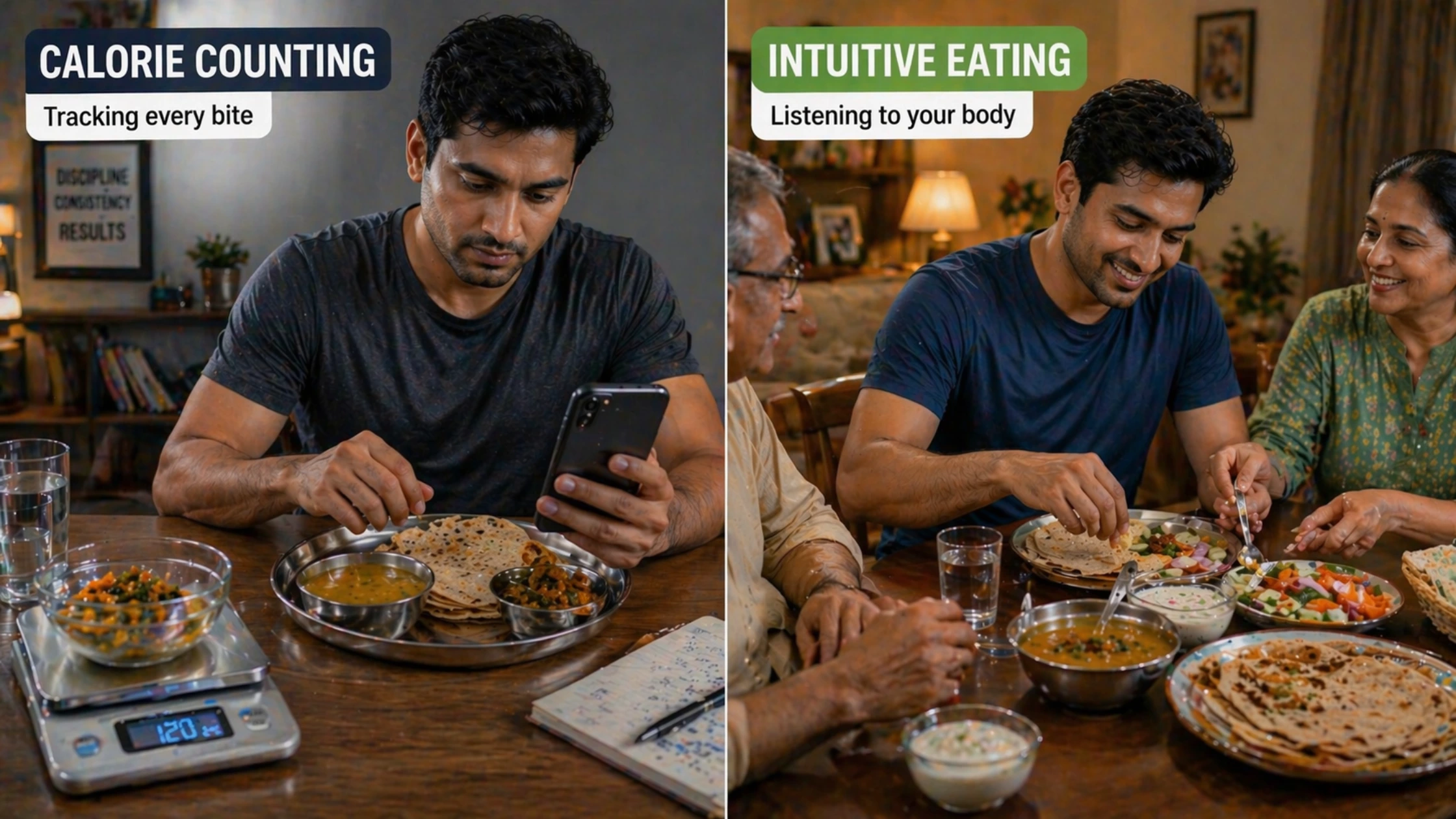
The calorie counting versus intuitive eating debate has a nuanced answer for Indian consumers specifically. Calorie counting — systematically tracking food intake against a numerical target — produces significantly better short-term weight loss outcomes in clinical trials: studies show 15 to 20% more weight lost over 12 weeks compared to unstructured eating approaches. Intuitive eating — eating in response to hunger and satiety signals without tracking numbers — produces better long-term psychological outcomes, lower rates of disordered eating, and comparable
weight maintenance once goal weight is reached. For Indians specifically, calorie counting has additional value because Indian food is highly variable in calorie density (a restaurant biryani can contain 2 to 3 times the calories of home-cooked biryani) and portion sizes are culturally fluid. The most effective approach for most Indians is tracked intuitive eating — using data for 4 to 8 weeks to calibrate hunger signals, then transitioning to more intuitive eating with periodic data checks. Nutrimate supports both approaches through flexible logging options.
What Calorie Counting Actually Is — And What It Is Not
Calorie counting is frequently misunderstood as an obsessive, joy-removing practice that requires weighing every grain of rice and logging every sip of water. Done correctly, it is simply a system of awareness — a way of understanding what you are consuming relative to what your body needs.
The genuine value of calorie counting is not in the numbers themselves but in the calibration it produces. Most people — including nutritionists, doctors, and fitness professionals — are poor at estimating portion sizes and calorie densities without training. Research consistently shows that people underestimate their caloric intake by 20 to 50%. An Indian eating 2,000 calories per day may genuinely believe they are eating 1,500.
Calorie counting corrects this miscalibration. After 4 to 8 weeks of consistent tracking, most people develop a reasonably accurate sense of portion sizes and food choices without needing to look up numbers. The tracking period builds the intuition that intuitive eating relies upon.
What Intuitive Eating Is — Beyond the Social Media Version
Intuitive eating is not eating whatever you want whenever you want it. It is a structured framework developed by dietitians Evelyn Tribole and Elyse Resch that involves tuning into genuine hunger and fullness signals, distinguishing between emotional and physical hunger, and making food choices from a place of body respect rather than diet culture rules.
The framework explicitly includes nutrition knowledge as a component. Intuitive eating does not advocate ignoring what foods do to the body — it advocates not using that knowledge to punish or restrict beyond what health requires.
The research on intuitive eating shows that it produces better psychological outcomes — lower rates of binge eating, better body image, lower anxiety around food — compared to rigid calorie restriction. Weight outcomes are mixed: intuitive eating is not consistently superior to tracked approaches for weight loss, but it is superior for weight maintenance and psychological wellbeing.
The Indian Food Problem With Intuitive Eating
Intuitive eating assumes a relatively consistent food environment — one where your hunger signals are well calibrated to your actual caloric needs. Indian eating complicates this in specific ways.
Indian social eating involves multiple people serving you food, cultural pressure to accept second helpings, and variable portion sizes depending on who is cooking and where you are eating. A home-cooked dal at your mother’s house may contain 100 calories per katori. The same dal at a restaurant may contain 180 calories due to more oil and cream. Your hunger signal gives you no information about this difference.
Additionally, many common Indian foods are extremely calorie-dense in small volumes — ghee, coconut milk, deep fried preparations, mithai — making it easy to consume large caloric surpluses without feeling proportionally full.
The Optimal Approach for Indians — Tracked Intuitive Eating
The most evidence-based and practically effective approach for most Indian adults is a phased strategy. Phase one— tracking for 4 to 8 weeks — uses calorie counting to build accurate food awareness and calibrate hunger signals. This phase is not about perfection — it is about education.
Phase two — flexible tracking — involves maintaining awareness of broad targets while allowing estimation for familiar foods. You know approximately what your usual lunch provides. You track carefully when eating out or eating unfamiliar foods. You check in with the data weekly rather than daily.
Phase three — intuitive maintenance — uses periodic data checks to confirm that habits are still aligned with health goals. If weight drifts upward over several months, a brief return to consistent tracking recalibrates before the drift becomes significant.
Using Nutrimate for Both Approaches Flexibly
Nutrimate is designed to support all three phases. During the tracking phase, the Indian food database and WhatsApp logging make consistent logging as low-friction as possible — so the habit forms before the motivation fades. During flexible tracking, the Health Score provides a daily summary without requiring precise numerical logging. During intuitive maintenance, periodic review of monthly trends in the app provides the recalibration check that prevents gradual drift.
The goal is not to count calories forever. The goal is to count calories long enough that you no longer need to —because you have developed the food awareness and meal planning habits that make intuitive eating genuinely effective.
Start with tracked eating, build food awareness, transition to intuitive eating. Nutrimate supports both. Free on Android and iOS — nutrimate.in