 Pradnya Ganorkar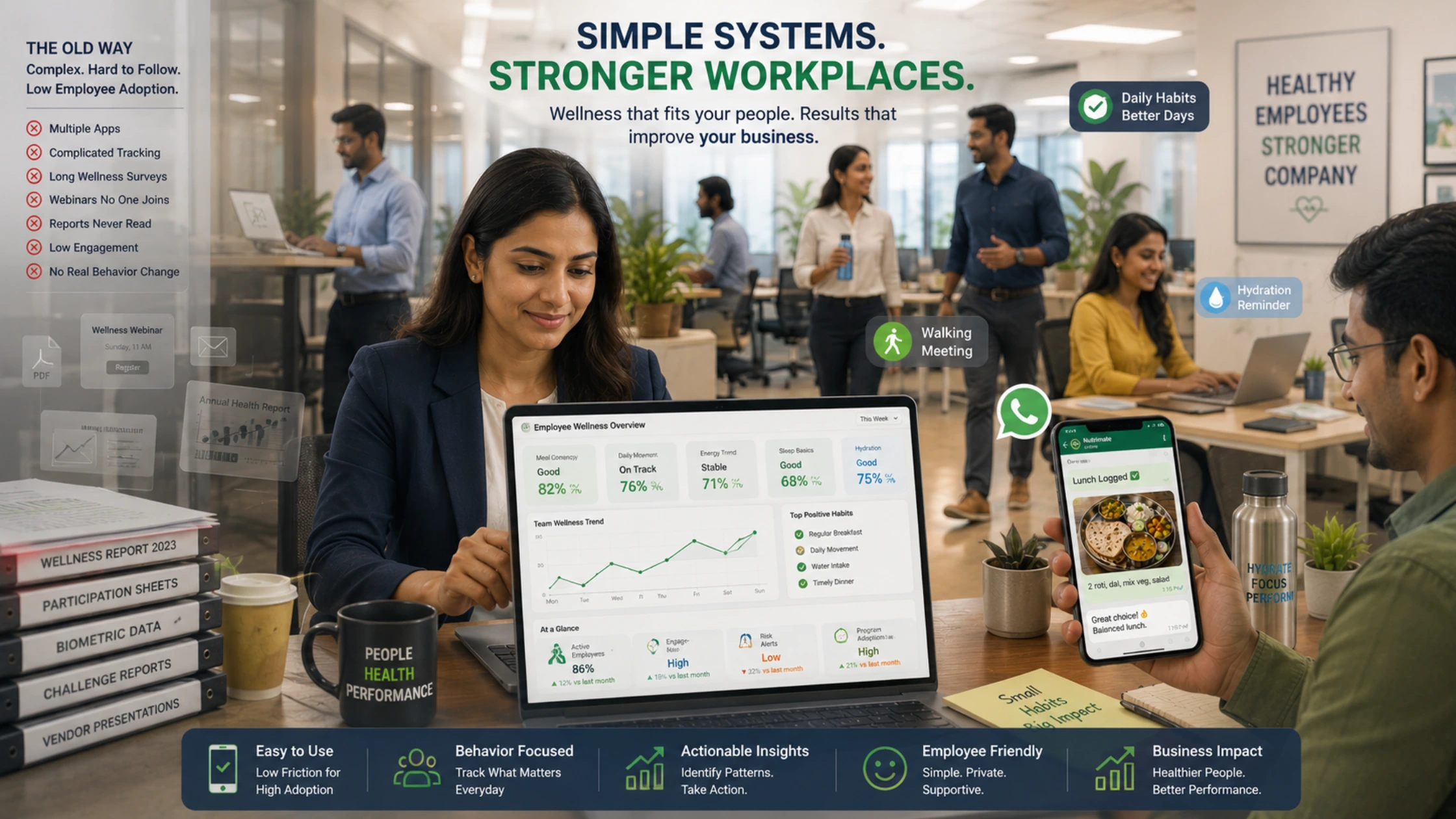
For many HR leaders, founders, and operations teams across India, corporate wellness often starts with strong intent.
A wellness webinar is booked.
A yoga session is organized.
A step challenge launches.
A wellness platform subscription is purchased.
For a few days, participation looks promising.
Then reality sets in.
Attendance drops.
Engagement fades.
Dashboards go unused.
Employees return to old patterns.
This is one of the biggest reasons many organizations struggle with corporate wellness tools India.
The problem is often not budget.
It is system complexity.
Many companies assume more features create better wellness.
But in practice, employees often ignore systems that feel:
- Time-consuming
- Complicated
- Disconnected from daily life
- Hard to maintain
This is why many modern workplace wellness engagement tools are shifting away from feature-heavy models toward frictionless daily systems.
Because employees do not need more wellness information.
They often need easier wellness execution.
This is where employee wellness system design becomes critical.
The best systems usually fit into existing employee routines instead of demanding major behavioral disruption.
Across Indian workplaces, this increasingly means:
- Simple employee health tracking solutions
- Daily habit visibility
- Low-effort nutrition tracking
- Familiar tools
- Better preventive health
This is also why practical systems like India’s #1 whatsapp meal logging feature and Unique Caregiver feature are becoming increasingly relevant in corporate environments.
Because adoption usually depends less on features, and more on usability.
If employees do not use the system consistently, the program rarely works.
Why Complex Systems Fail: corporate wellness tools India, employee wellness system, and workplace wellness engagement tools
Many companies make one major mistake:
They build wellness systems for ideal behavior, not real behavior.
Common Corporate Pattern:
HR invests in:
- Advanced apps
- Multi-step dashboards
- Health portals
- Manual logging systems
Expected Outcome:
Employees actively engage.
Actual Outcome:
Low adoption.
Why?
Because most employees are already managing:
- Deadlines
- Meetings
- Family
- Commutes
- Mental fatigue
When wellness becomes another operational burden, usage declines.
Indian Workplace Reality:
A mid-level employee may already feel overwhelmed by:
- Slack
- Calls
- Reports
Adding a complex wellness platform can feel like “more work.”
Major Reasons Complex Systems Fail:
1. Too Much Friction
Too many steps reduce consistency.
2. Poor Habit Fit
Systems often ignore real employee routines.
3. Generic Advice
Employees disengage when systems feel impersonal.
4. Low Immediate Relevance
People prioritize what feels easy now.
Myth vs Reality
Myth: More features = better employee participation wellness
Reality: Simplicity often drives stronger client engagement
What Employees Actually Want: employee health tracking solutions, digital wellness platform India, and health tracking tools
Most employees are not asking for more health complexity.
They are asking for:
“Make health easier.”
What Modern Employees Respond To:
1. Low-Effort Systems
Fast, simple inputs
2. Familiar Interfaces
WhatsApp, mobile-first systems, passive reminders
3. Practical Relevance
Indian meals, Indian schedules, Indian habits
4. Non-Disruptive Awareness
Tracking without overthinking
Example:
A sales professional traveling across cities is less likely to use:
Detailed manual food logs
But more likely to use:
Simple daily meal visibility
Key Insight:
The best employee health tracking solutions often reduce mental load.
What Employees Usually Ignore:
- Complicated dashboards
- Generic PDFs
- One-time wellness talks
- Heavy compliance systems
What They Use More:
- Easy meal awareness
- Habit prompts
- Simplicity-driven health tracking tools
The Simplicity Advantage: workplace wellness engagement tools, preventive health monitoring tools, and nutrition tracking
Simplicity is not lack of sophistication.
It is strategic design.
Why Simplicity Works:
1. Better Adoption
Lower effort = higher participation
2. Better Consistency
Repeatable systems create behavior patterns
3. Better Data
Frequent low-friction use improves visibility
4. Better Preventive Value
Small daily insights often outperform occasional interventions
Corporate Example:
Traditional model:
Quarterly health camp
Problem:
Awareness spike, then drop
Better model:
Simple daily habit visibility
Benefit:
- Better preventive health monitoring tools
- More sustained awareness
- Higher long-term participation
Important:
Employees do not need constant pressure.
They need sustainable systems.
Nutrimate Example:
Nutrimate’s AI-powered, Indian-first approach reflects this by aligning nutrition tracking with existing WhatsApp habits instead of adding app fatigue.
Step-by-Step System Setup: corporate wellness tools India, employee health tracking solutions, and workplace wellness engagement tools
A strong corporate wellness system should prioritize behavior before features.
Step 1: Identify Core Daily Metrics
Focus on:
- Meal consistency
- Activity
- Sleep basics
- Energy patterns
Step 2: Remove Complexity
Avoid:
- Calorie obsession
- Multi-screen dashboards
- Heavy onboarding
Step 3: Use Familiar Tools
This is where India’s #1 whatsapp meal logging feature and Unique Caregiver feature can improve adoption by reducing friction.
Step 4: Build Habit Awareness
Prioritize:
- Daily visibility
- Pattern recognition
- Behavioral trends
Step 5: Support, Don’t Police
Employees resist systems that feel invasive.
Step 6: Use HR Strategically
HR should monitor aggregate trends, not micromanage individuals.
Strategic Outcome:
Better:
- corporate wellness
- client engagement
- preventive health
- Employee trust
Example Workflow: digital wellness platform India, employee wellness system, and health tracking tools
Scenario:
500-employee Indian IT company
Old Model:
- Monthly webinars
- Fitness challenge
- Limited long-term engagement
New Simple Model:
Daily optional:
- Meal awareness
- Movement tracking
- Habit nudges
Employee Experience:
Low effort
HR Experience:
Actionable pattern insights
Result:
Higher adoption because wellness became operationally easier.
Strategic Lesson:
People sustain what feels manageable.
Mistakes to Avoid: corporate wellness tools India, workplace wellness engagement tools, and employee health tracking solutions
DON’T:
- Build feature-heavy systems
- Over-prioritize dashboards
- Assume awareness = behavior
- Add operational burden
- Force unrealistic routines
- Ignore Indian food and lifestyle realities
DO:
- Prioritize simplicity
- Reduce friction
- Build around real schedules
- Use easy nutrition tracking
- Focus on daily systems
- Improve preventive health
Strategic Shift: Wellness Programs Should Fit Employees, Not the Other Way Around
The future of corporate wellness tools India is not more programs.
It is better systems.
Because:
More sessions do not guarantee behavior change.
Better usability does.
Core Truth:
If wellness feels like extra work, participation falls.
If wellness fits daily life, consistency rises.
This is why modern employee wellness system design increasingly focuses on:
Simplicity
Familiarity
Visibility
Sustainability
For HR leaders, the real question is no longer:
“Do we have a wellness program?”
It is:
“Do employees actually use it?”
Because real wellness begins where adoption becomes natural.
Frequently Asked Questions
An effective wellness program is built by reducing friction, simplifying daily health tracking, focusing on employee usability, and creating systems that fit real employee routines instead of relying only on one-time wellness events.
Employees typically use low-friction, familiar tools like WhatsApp-based systems, simple meal tracking, easy habit visibility platforms, and wellness tools that require minimal extra effort while fitting naturally into daily life.