 Pradnya Ganorkar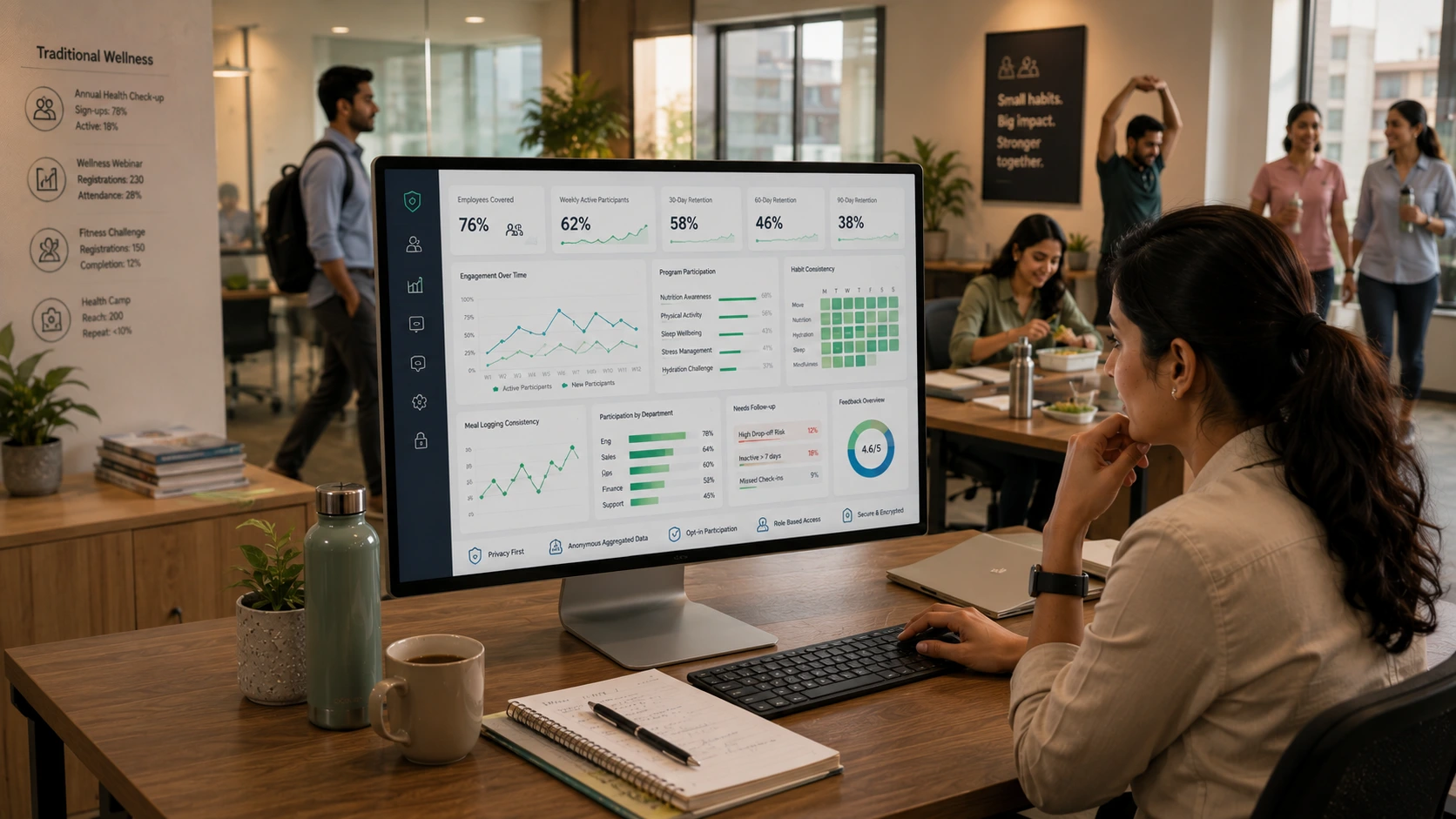
Many companies invest in annual health checks, fitness challenges, webinars, and wellness campaigns, yet still struggle to understand whether employees are actually building healthier routines.
This is the central challenge for organizations evaluating employee health tracking solutions. Collecting more data does not automatically create better decisions. Effective employee health monitoring should help HR teams understand patterns in everyday health behaviours, participation, and engagement while protecting employee privacy.
For Indian organizations, the goal should be practical: measure the behaviours that influence employee wellbeing, identify where employees need support, and use aggregated insights to improve the overall corporate wellness strategy.
Why Measuring Wellness Is So Difficult
Employee health is influenced by multiple factors.
Nutrition, movement, sleep, stress, hydration, work schedules, commuting time, family responsibilities, and workplace culture can all affect everyday wellbeing.
This makes measuring workplace wellness more complicated than tracking a single business KPI.
For example, an IT company may have high participation in a wellness webinar but low daily movement among employees working long hours at desks.
A manufacturing organization may complete annual health assessments but have limited visibility into whether employees are improving nutrition, sleep, or activity habits between assessments.
A startup may provide gym memberships, yet employees dealing with long working hours and workplace stress may rarely use them.
The problem is not necessarily a lack of wellness initiatives.
The problem is that many organizations measure activities rather than behavioural outcomes.
Good health analytics should answer practical questions:
Are employees becoming more engaged with their health?
Are healthier behaviours becoming more consistent?
Which wellness activities are being used?
Where does engagement decline?
Which employee groups may benefit from additional support?
The purpose of measurement is not to collect every possible data point.
It is to understand enough to make better decisions.
The Problem With Measuring Only Participation
Participation is useful, but it provides an incomplete picture.
Suppose 600 employees register for a nutrition webinar.
Four hundred attend.
The HR team reports 67 percent participation.
But what happened afterward?
Did employees improve meal awareness?
Did they begin walking regularly?
Did hydration improve?
Did employees continue engaging with the employee wellness program India initiative?
Did the programme contribute to meaningful behavior change?
Attendance cannot answer these questions.
This is why organizations need to separate activity metrics from outcome-oriented engagement metrics.
Activity metrics include:
- Webinar registrations.
- Health camp attendance.
- Challenge sign-ups.
- App downloads.
- Initial assessments completed.
Behaviour and engagement metrics include:
- Consistency of participation over time.
- Frequency of nutrition logging.
- Weekly activity patterns.
- Habit completion.
- Repeat engagement.
- Programme retention.
- Changes in aggregated health risk patterns.
The strategic shift is simple.
Do not ask only, “How many employees participated?”
Ask, “What happened after employees participated?”
Effective workplace wellness engagement tools should help organizations understand sustained participation rather than measuring isolated events.
Health Metrics That Actually Matter
A practical employee health measurement framework should focus on a limited number of meaningful indicators.
Nutrition
Nutrition patterns can provide useful insight into everyday health behaviours.
Organizations do not need access to every employee’s detailed food choices.
Aggregated nutrition tracking patterns can help wellness teams understand:
- Meal logging consistency.
- Participation in nutrition programmes.
- Meal regularity.
- Engagement with nutrition education.
- Changes in broad eating behaviours over time.
For Indian workplaces, nutrition initiatives should consider real eating environments such as office canteens, tiffin meals, shift schedules, frequent chai breaks, food delivery, and regional dietary preferences.
Tracking should create awareness, not judgement.
Activity
Daily movement is more informative than participation in one fitness challenge.
Useful indicators may include:
- Active days per week.
- Walking challenge participation.
- Consistency of movement.
- Exercise habit completion.
- Engagement with activity programmes.
A company may discover that employees enthusiastically join a 30-day step challenge but participation declines sharply after the first week.
That is valuable information for improving employee engagement.
Sleep
Sleep affects concentration, recovery, mood, and everyday wellbeing.
Organizations should avoid intrusive individual-level surveillance.
Instead, voluntary and aggregated reporting can help identify broad patterns related to sleep awareness and engagement with healthy sleep initiatives.
The purpose of health monitoring is to guide support, not create unnecessary oversight.
Stress
Stress measurement requires particular care.
Anonymous surveys, pulse checks, programme utilization trends, and aggregated wellbeing assessments can help organizations understand changes in workplace stress.
The objective should be improving workplace wellbeing, not evaluating individual employee performance.
Water intake
Hydration is a simple behaviour that can be included in workplace challenges or habit-building programmes.
Organizations can measure voluntary participation and consistency rather than requiring detailed individual monitoring.
Simple health behaviours can be useful because they are easier for employees to understand and repeat.
Engagement
Engagement is one of the most important metrics.
Useful employee engagement metrics include:
- Weekly active participants.
- Repeat participation.
- Habit completion rates.
- Challenge retention.
- Percentage of employees remaining active after 30, 60, or 90 days.
- Engagement by department or employee group.
- Drop-off points in the wellness journey.
A strong corporate wellness platform should help HR teams understand whether employees continue participating after the initial launch excitement disappears.
Leading Indicators vs Lagging Indicators
HR teams should understand the difference between early behavioural signals and long-term business outcomes.
| Leading Indicators | Lagging Indicators |
| Weekly wellness participation | Absenteeism trends |
| Nutrition logging consistency | Healthcare cost trends |
| Activity habit completion | Long-term health risk changes |
| Repeat programme engagement | Employee retention |
| Sleep and stress programme participation | Productivity trends |
| Use of preventive health monitoring tools | Changes in organizational health outcomes |
Leading indicators show what employees are doing now.
Lagging indicators show the outcomes that may appear later.
For example, increasing participation in daily movement initiatives does not immediately prove that absenteeism will decline.
However, consistent participation can indicate whether employees are actually engaging with the organisation’s corporate health strategy.
Organizations need both types of measurement.
Leading indicators help teams improve programmes quickly.
Lagging indicators help leadership evaluate longer-term business impact and wellness ROI.
Creating a Simple Employee Health Dashboard
An effective employee health dashboard should simplify decision-making.
It should not become a collection of every available wellness metric.
A practical dashboard may include:
1. Reach
How many eligible employees have joined the programme?
2. Activation
How many employees completed the first meaningful health action?
This could include recording a meal, completing a health assessment, joining an activity challenge, or setting a wellness goal.
3. Engagement
How many employees continue participating weekly or monthly?
4. Consistency
How regularly are employees repeating agreed health behaviours?
5. Retention
How many employees remain active after 30, 60, or 90 days?
6. Health trends
What broad changes are visible in aggregated nutrition, activity, sleep, stress, or other voluntary health indicators?
7. Programme improvement
Where are employees dropping out, and which initiatives create stronger ongoing engagement?
This type of corporate health dashboard helps HR teams move from reporting activities to understanding behaviour.
Technology can support this process, but it should not become the centre of the wellness strategy.
Nutrimate demonstrates this awareness-first approach through simple health tracking, Indian meal intelligence, and practical habit visibility. Its India’s #1 whatsapp meal logging feature and Unique Caregiver feature reflect a broader principle: tracking should fit naturally into daily routines rather than create another complicated health process.
For organizations exploring scalable wellness infrastructure, the focus should remain on privacy-conscious employee health tracking solutions that use voluntary participation, appropriate consent, aggregated reporting, role-based access, and clear data governance.
FitVia, Nutrimate Wellness’s B2B fitness ecosystem for gym owners, trainers, influencers, and dietitians, offers a useful example of how dashboards, Health Score visibility, nutrition tracking, progress reports, analytics, and engagement tools can bring behavioural information into one structured system. The same measurement principle applies in workplace wellness: organizations need actionable trends and aggregated insights rather than unnecessary access to individual health details.
Continuous tracking can provide better insight than one-time assessments, but more data is not always better.
A good digital wellness platform India strategy should collect only information that supports clearly defined wellness objectives.
Health Measurement Checklist
☐ Define what business and employee health problems the programme is trying to address.
☐ Choose a limited number of meaningful wellness metrics.
☐ Measure behaviours, not only event attendance.
☐ Track participation over time instead of reporting only registrations.
☐ Include nutrition, activity, sleep, stress, hydration, and engagement only when relevant to programme goals.
☐ Separate leading indicators from long-term business outcomes.
☐ Use workplace health analytics to identify patterns and improve programme decisions.
☐ Measure 30-day, 60-day, and 90-day engagement.
☐ Identify where employees stop participating.
☐ Use voluntary participation and clearly communicate what information is collected.
☐ Prefer aggregated reporting for organizational decision-making.
☐ Restrict access to sensitive employee information.
☐ Avoid using wellness data for employee performance evaluation.
☐ Use health tracking tools that support appropriate consent, security, and responsible data practices.
☐ Review whether collected information is actually being used to improve programmes.
☐ Connect employee health monitoring with practical interventions and employee support.
☐ Evaluate long-term outcomes such as participation trends, health risks, absenteeism, retention, and wellness ROI.
☐ Improve the programme continuously based on employee feedback and behavioural patterns.
FAQs
Employers should measure a focused combination of programme reach, activation, repeat participation, behaviour consistency, retention, and relevant aggregated health trends. Effective employee health tracking solutions should help organizations understand whether healthier behaviours are being adopted over time, not simply how many employees attended wellness activities.
The most useful metrics depend on programme objectives, but they may include weekly active participants, repeat engagement, habit completion, nutrition and activity participation, 30-day and 90-day retention, programme drop-off points, and longer-term organizational outcomes. Strong health analytics should connect employee behaviour with decisions that improve programme design.
Companies can use voluntary assessments, surveys, wellness challenges, aggregated nutrition tracking, activity programmes, habit tracking, health risk assessments, and privacy-conscious digital systems. Responsible workplace health tracking should use clear consent, collect only necessary information, protect sensitive data, and emphasize aggregated insights for organizational decision-making.
A wellness dashboard is a reporting system that brings relevant participation, engagement, behavioural, and health trend metrics into one view. A useful dashboard helps HR teams identify programme reach, engagement patterns, participation drop-offs, consistency, and long-term trends so they can make better corporate wellness decisions.
Reference:
- The World Health Organization and International Labour Organization provide guidance on mental health at work, including organizational interventions, worker participation, and workplace policies that support employee wellbeing.
WHO and ILO Mental Health at Work Policy Brief - India’s Digital Personal Data Protection Act, 2023 establishes requirements related to lawful processing, consent, data protection obligations, and individual rights that organizations should consider when designing employee health data collection and digital wellness programmes.
Digital Personal Data Protection Act 2023