 Pradnya Ganorkar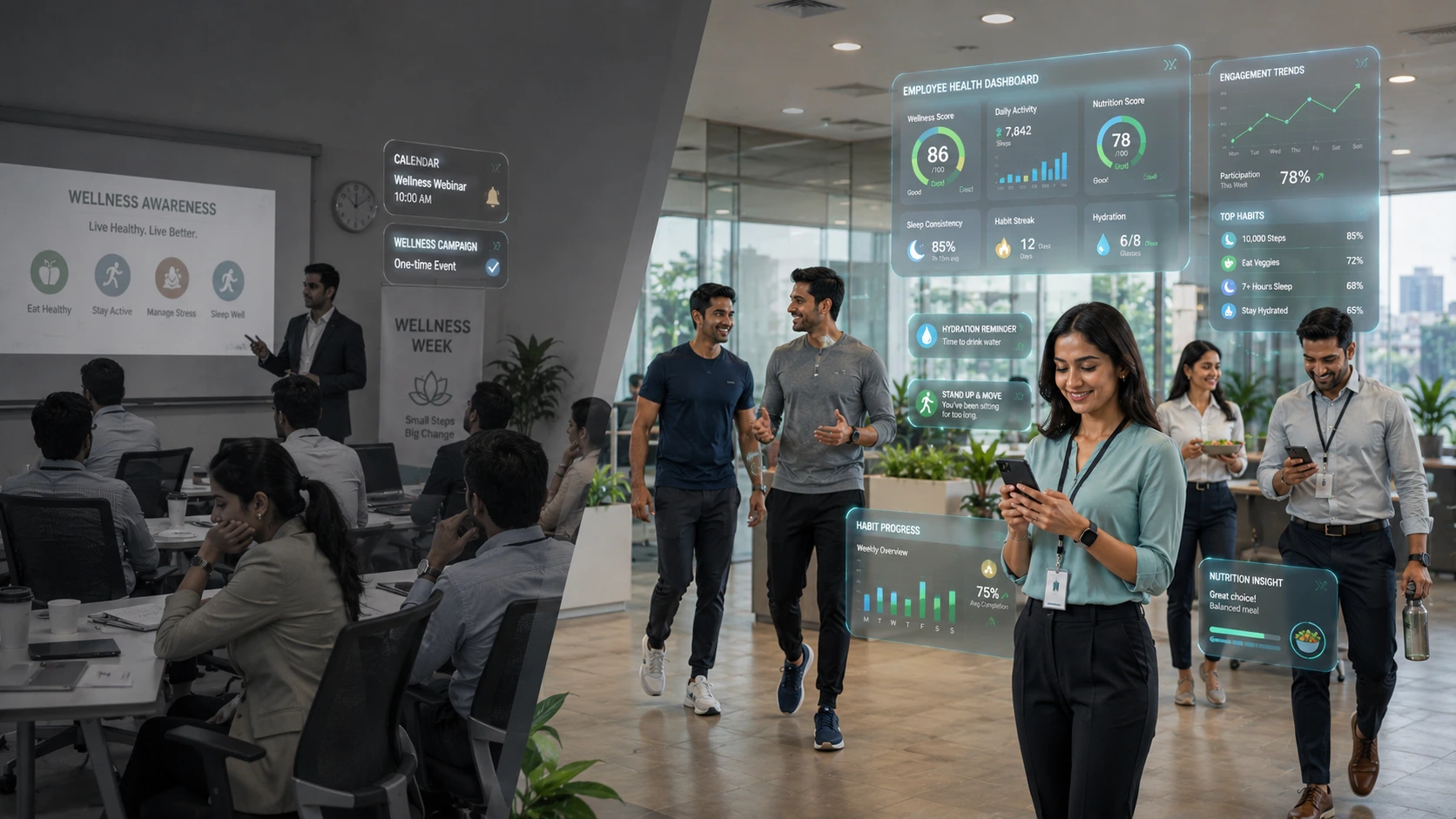
Organizations across India are investing heavily in employee wellbeing.
From yoga sessions and health webinars to annual wellness campaigns, companies recognize that healthier employees are more productive, engaged, and resilient.
Yet despite growing investments, many leaders still struggle to see meaningful behavior change.
Employees attend wellness events.
They complete health assessments.
They participate in challenges.
Then, within weeks, most return to their previous routines.
This raises an important question:
Why do so many employee wellness program India initiatives fail to create lasting impact?
The answer is surprisingly simple.
Most programs focus on awareness instead of action.
They provide information but fail to create daily engagement.
They educate employees but do not help them build sustainable habits.
Real behavior change requires visibility, consistency, and systems that fit naturally into everyday life.
Modern organizations are increasingly adopting workplace wellness engagement tools, employee health tracking solutions, and preventive health monitoring tools because long-term wellness is driven by daily behavior, not occasional events.
The Wellness Participation Problem
Most organizations do not struggle to launch wellness initiatives.
They struggle to sustain participation.
A company may organize:
- Nutrition workshops
- Yoga classes
- Mental wellness webinars
- Step challenges
- Annual health screenings
Participation often starts strong.
Then engagement declines rapidly.
Why Participation Drops
Employees already face:
- Heavy workloads
- Long commuting hours
- Hybrid work challenges
- Family responsibilities
- Digital fatigue
Adding another platform, another webinar, or another challenge rarely solves the problem.
This is particularly relevant given today’s increasing workplace stress levels and growing concerns around preventive healthcare India.
Employees do not necessarily need more information.
They need simpler ways to act on that information.
Awareness Does Not Equal Action
Many corporate wellness initiatives assume that education automatically creates behavior change.
Unfortunately, it doesn’t.
Most employees already know:
- Exercise is important.
- Sleep matters.
- Processed foods should be limited.
- Stress affects health.
The challenge is not knowledge.
The challenge is execution.
Why Awareness Doesn’t Create Behavior Change
Health behavior is influenced by environment, habits, convenience, and consistency.
A webinar may increase awareness for one hour.
Behavior change requires support every day.
The Corporate Wellness Gap
Many organizations measure:
- Event attendance
- Webinar registrations
- Program sign-ups
But these metrics do not necessarily reflect health improvement.
What matters more is:
- Daily engagement
- Habit formation
- Long-term participation
- Health trend improvement
Without visibility into daily behaviors, companies cannot understand whether employees are actually improving.
This is where modern corporate wellness software and digital wellness platform India solutions are changing the conversation.
Instead of focusing solely on events, they help organizations track engagement patterns over time.
Example
Imagine two employees:
Employee A attends every wellness webinar.
Employee B rarely attends webinars but consistently walks daily, sleeps well, and follows healthy eating habits.
Which employee is creating better long-term outcomes?
The answer is obvious.
Behavior matters more than participation.
Common Corporate Wellness Mistakes
Many organizations repeat the same wellness mistakes year after year.
Mistake 1: Treating Wellness as a Campaign
Wellness is often approached like a marketing campaign.
A company launches a 30-day initiative and expects permanent results.
Health does not work this way.
Effective programs focus on continuous engagement.
Mistake 2: Focusing Only on Fitness
Many organizations emphasize exercise while ignoring:
- Nutrition
- Sleep
- Stress management
- Recovery
- Family wellbeing
A complete wellness strategy should address multiple health drivers.
Mistake 3: No Measurement Framework
Without measurement, organizations cannot evaluate success.
Tracking only attendance creates an incomplete picture.
Modern wellness programs increasingly rely on:
- Employee health dashboard
- Corporate health dashboard
- Workplace health tracking
- Engagement trends
- Habit adherence metrics
Mistake 4: Making Participation Complicated
The more effort required, the lower participation becomes.
Employees do not want multiple apps, forms, and portals.
Simplicity consistently outperforms complexity.
Mistake 5: Ignoring Family Influence
Health decisions rarely occur in isolation.
Family habits strongly influence:
- Food choices
- Sleep patterns
- Activity levels
- Stress management
Organizations that recognize family influence often achieve better engagement outcomes.
What Employees Actually Need
Successful wellness programs focus less on information and more on daily support.
Employees Need Visibility
People improve what they can see.
Without awareness, unhealthy behaviors remain invisible.
Examples include:
- Skipping breakfast
- Low protein intake
- Poor hydration
- Excessive snacking
- Sedentary workdays
Simple visibility helps employees make better decisions.
Employees Need Simplicity
The best wellness systems reduce effort.
For example:
- Quick habit tracking
- Easy meal logging
- Automated reminders
- Personalized insights
This is one reason WhatsApp-based wellness experiences are gaining popularity in India.
Employees already use WhatsApp daily.
No additional learning curve is required.
Employees Need Consistency
A weekly wellness event cannot compete with daily habits.
Organizations should focus on:
- Small actions
- Frequent engagement
- Sustainable participation
These approaches align more closely with real-world behavior change.
Building Daily Engagement Systems
Organizations that achieve stronger results typically build systems rather than events.
Create Daily Touchpoints
Examples include:
- Daily hydration reminders
- Nutrition awareness prompts
- Walking challenges
- Habit streak tracking
- Health score monitoring
Small interactions create momentum.
Use Data for Personal Relevance
Employees engage more when feedback feels personal.
Examples:
- Activity trends
- Sleep patterns
- Nutrition consistency
- Wellness scores
Many organizations are now exploring corporate wellness tools India that provide personalized insights instead of generic content.
Leverage Existing Behaviors
The easiest behavior to change is the one that requires the least additional effort.
This is why platforms that integrate into familiar environments often see stronger engagement.
For example, Nutrimate enables health tracking through simple WhatsApp-based interactions rather than requiring employees to learn a complex new system.
The platform includes India’s #1 whatsapp meal logging feature and Unique Caregiver feature, helping organizations support employee wellbeing while also recognizing family health influences.
Create Social Accountability
Healthy behavior becomes easier when supported by peers.
Examples include:
- Team challenges
- Department leaderboards
- Wellness communities
- Recognition systems
The goal is motivation through encouragement rather than pressure.
Measuring Real Outcomes
One of the biggest weaknesses in traditional wellness programs is poor measurement.
Organizations often track participation but ignore outcomes.
Metrics That Matter
Instead of asking:
“How many employees attended?”
Ask:
“How many employees improved their habits?”
Useful indicators include:
- Daily engagement rate
- Wellness participation consistency
- Health improvement trends
- Retention rates
- Habit completion rates
Health Visibility Metrics
Modern platforms increasingly provide:
- Employee health dashboard
- Corporate health dashboard
- Workplace health analytics
- Wellness engagement reports
- Population-level health insights
These metrics provide far greater value than webinar attendance numbers.
Wellness ROI
Leaders frequently ask about wellness ROI.
The most meaningful outcomes include:
- Reduced absenteeism
- Improved engagement
- Better productivity
- Lower burnout risk
- Higher employee satisfaction
Wellness ROI is not created by one event.
It is created through consistent behavior change.
Lessons From Other Engagement Platforms
The same principle applies across industries.
For example, fitness platforms such as FitVia help gyms, trainers, and wellness professionals improve engagement through ongoing visibility rather than one-time interactions.
Features such as progress tracking, health scores, nutrition visibility, and regular check-ins demonstrate how consistent engagement systems outperform isolated activities.
Corporate wellness programs can apply the same principle.
Visibility creates accountability.
Accountability creates action.
Action creates results.
Corporate Wellness Checklist
Before launching or evaluating a wellness initiative, ask:
✓ Does the program support daily engagement?
✓ Is participation easy and convenient?
✓ Are employees receiving personalized insights?
✓ Are wellness metrics being measured beyond attendance?
✓ Is there a system for tracking habits?
✓ Does the program support nutrition, activity, sleep, and stress management?
✓ Are outcomes being measured over time?
✓ Is employee feedback being used?
✓ Can employees engage without downloading multiple platforms?
✓ Does the program encourage sustainable behavior change?
Organizations that answer “yes” to most of these questions are significantly more likely to create meaningful health outcomes.
Reference
- World Health Organization Workplace Health Promotion
- Centers for Disease Control and Prevention (CDC) Workplace Health Mode
FAQs
Most wellness programs fail because they focus on awareness rather than sustained behavior change. Employees may attend events, but without daily engagement systems, long-term habits rarely improve.
Companies can improve participation by simplifying engagement, providing personalized insights, integrating wellness into daily routines, and using workplace wellness engagement tools that support consistent interaction.
A successful wellness program creates ongoing participation, supports habit formation, measures real outcomes, and provides visibility into employee health trends through practical and easy-to-use systems.