 Pradnya Ganorkar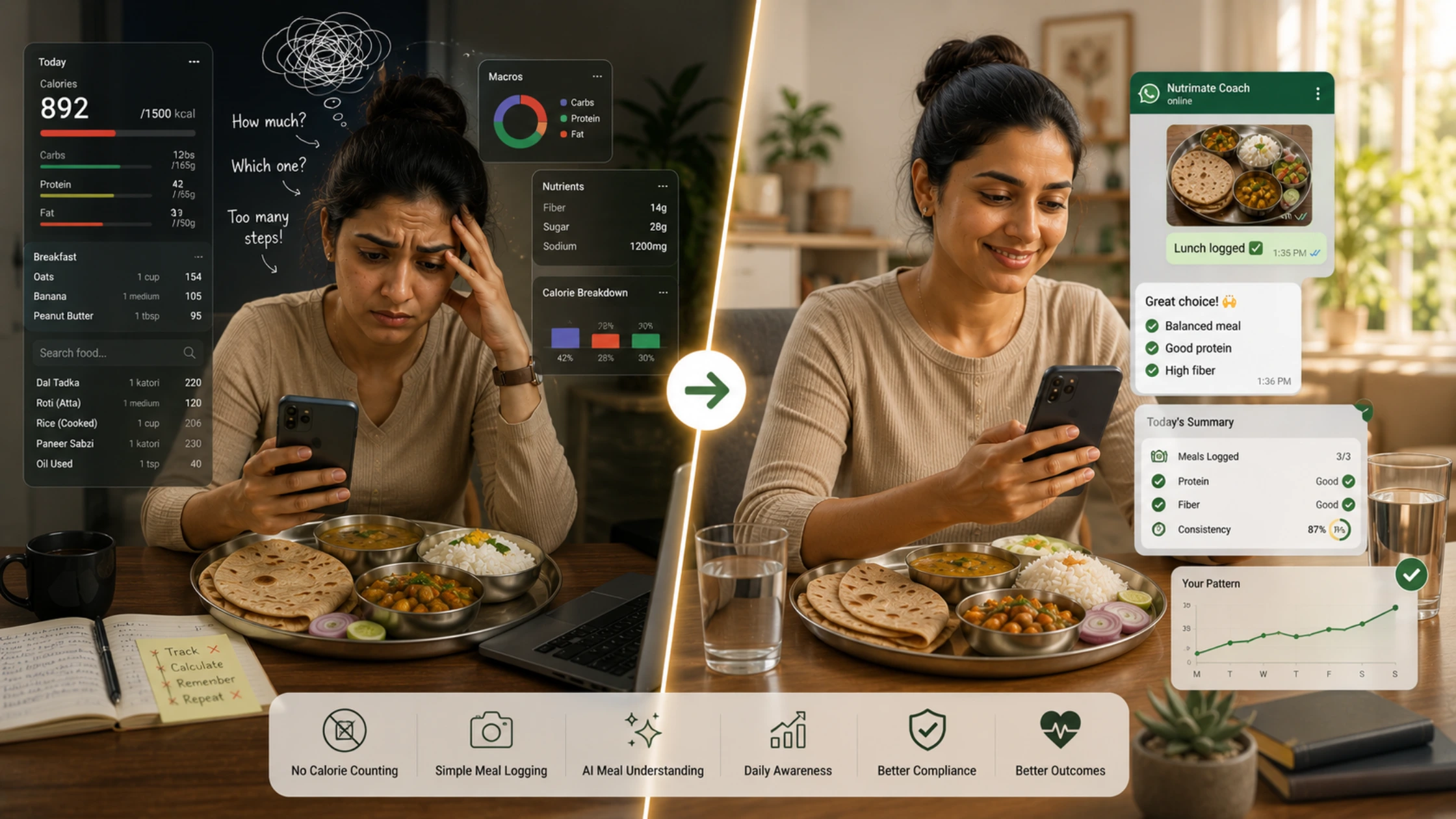
For many Indians trying to build a healthy lifestyle, one problem shows up quickly:
You want to eat better.
You want more awareness.
You may even start strong.
Then tracking begins to feel exhausting.
Open app.
Search food.
Guess portion.
Log ingredients.
Repeat for roti, dal, sabzi, chai, snacks.
By day three, most people stop.
This is one of the biggest reasons simple meal tracking for Indian food matters more today than ever before.
The problem is not always motivation.
The problem is friction.
For many people, traditional calorie counting feels too technical, too repetitive, and too disconnected from real Indian eating habits. Most Indians do not eat standardized meals. They eat home food, shared meals, office snacks, festival foods, travel meals, and regional dishes.
This is why food tracking without calorie counting is becoming more relevant for people who want consistency without overwhelm.
For busy professionals, parents, gym members, and families, the easiest system is often the one they can actually sustain.
A practical easy way to track meals should not feel like homework.
It should fit:
- Indian food
- Busy schedules
- Real routines
- Family eating
- Long-term lifestyle change
This is why modern systems are moving toward meal tracking India solutions that prioritize simplicity over perfection.
Many people do not need perfect calorie precision every day.
They need visibility.
This is where newer systems like India’s #1 whatsapp meal logging feature and Unique Caregiver feature reflect a larger shift:
Make meal tracking fast enough to repeat.
Because when tracking becomes easier, consistency becomes more realistic.
And for most people, consistency matters more than perfect numbers.
Why Calorie Counting Feels Exhausting: simple meal tracking for Indian food, food tracking without calorie counting, and meal tracking India
Calorie counting sounds useful in theory.
Know your food.
Track intake.
Stay accountable.
But in real life, especially in India, it often breaks down.
Why?
Because most calorie systems were not designed around Indian meals.
Common Indian Food Challenges:
- Mixed sabzis
- Homemade dal
- Variable roti size
- Shared meals
- Regional dishes
- Family recipes
- Snacks without packaging
Example:
How do you accurately count:
- One bowl rajma chawal?
- Homemade poha?
- Aloo paratha with curd?
- Office samosa?
Most people either:
- Guess
- Skip logging
- Underestimate
- Quit entirely
Mental Fatigue:
Tracking every meal manually creates:
- Decision fatigue
- Guilt
- Time pressure
- Perfection anxiety
Myth vs Reality
Myth: More detailed tracking always works better
Reality: More complicated systems often reduce consistency
For many users, especially those focused on healthy lifestyle for busy Indians, sustainable awareness works better than obsession.
Why Most People Quit Tracking: food tracking without calorie counting, how to stay consistent with health, and sustainable health habits for Indians
Most people do not quit because they do not care.
They quit because the process becomes too difficult.
Common Reasons:
1. Time Consumption
Logging every ingredient is exhausting.
2. Inaccuracy
Users feel unsure:
“Is this 200 calories or 400?”
3. All-or-Nothing Thinking
Miss one meal → quit the day
4. Emotional Burnout
Tracking starts feeling restrictive.
Indian Lifestyle Reality:
Many people juggle:
- Work calls
- Commutes
- Family meals
- Irregular schedules
- Eating outside
This makes complex tracking unsustainable.
Behavioral Insight:
The harder the system, the lower the adherence.
This directly affects:
- how to stay consistent with health
- sustainable health habits for Indians
- simple health habits for working professionals
Strategic Truth:
A tracking system only works if it survives real life.
What Makes Tracking Easy: easy way to track meals, simple meal tracking for Indian food, and how to stay healthy without dieting
The best tracking system is not necessarily the most advanced.
It is the one people actually use.
Core Principles of Easy Tracking:
1. Low Friction
Minimal effort
2. Familiarity
Works with Indian meals
3. Speed
Takes seconds, not minutes
4. Visibility
Shows patterns clearly
5. Repeatability
Easy enough for daily use
Practical Example:
Instead of:
Search food → estimate → edit → log
Better:
Photo → simple input → pattern visibility
Why This Works:
When users reduce effort:
- Adherence improves
- Awareness improves
- Stress drops
- health habits become more sustainable
Important:
Tracking should support eating awareness.
Not create food anxiety.
This is especially relevant for people seeking how to stay healthy without dieting.
Because health often improves from understanding patterns, not rigid restriction.
Photo-Based / Simple Logging: meal tracking, simple meal tracking for Indian food, and easy way to track meals
One of the biggest shifts in modern meal tracking India is moving away from manual entry.
Why Photo-Based or Simplified Logging Works:
It matches natural behavior.
People already:
- Take photos
- Use WhatsApp
- Share food updates
- Use phones daily
Strategic Advantage:
Photo or quick logging reduces:
- Typing
- Searching
- Estimation fatigue
Indian-Specific Benefit:
This works better for:
- Thali meals
- Homemade meals
- Regional foods
- Family portions
Example:
Instead of manually entering:
2 rotis + dal + paneer + sabzi
Simple logging creates faster awareness.
Product Shift:
This is where tools like Nutrimate’s India’s #1 whatsapp meal logging feature and Unique Caregiver feature fit naturally into Indian behavior, because the process aligns with existing routines instead of forcing new habits.
Key Lesson:
The easier the system, the more likely people continue using it.
And long-term lifestyle change depends more on repeatability than intensity.
Step-by-Step Daily System: simple meal tracking for Indian food, healthy Indian eating habits, and Indian diet without dieting
A practical daily system should feel realistic.
Step 1: Log Main Meals
Breakfast
Lunch
Dinner
Step 2: Notice Patterns
- Late-night snacking
- Missed breakfast
- Weekend overeating
- Sugar-heavy tea
Step 3: Focus on Trends
Not perfection.
Step 4: Improve One Habit at a Time
Examples:
- Add protein
- Reduce mindless snacking
- Balance portions
Step 5: Keep It Sustainable
This supports:
- healthy Indian eating habits
- Indian diet without dieting
- food tracking without calorie counting
Real-Life Example:
Busy Mumbai professional:
Before:
Skipping breakfast, heavy dinner
After:
Simple logging reveals pattern
Fix:
Add morning protein
Result:
More awareness without calorie obsession
Important:
You do not need perfect nutrition data daily.
You need enough awareness to improve decisions.
Mistakes to Avoid: meal tracking India, why diets fail long term, and how to stay consistent with health
Even good systems fail when users overcomplicate them.
Common Mistakes:
DON’T:
- Track perfectly for 3 days, then quit
- Obsess over every calorie
- Feel guilty for family meals
- Ignore Indian food realities
- Use overly technical systems
DO:
- Prioritize speed
- Focus on patterns
- Build consistency
- Use flexible systems
- Track enough to stay aware
Biggest Mistake:
Treating tracking like punishment.
Better Approach:
Tracking = Awareness
Not control.
Strategic Reality:
Many people fail not because they lack discipline, but because their system does not fit their life.
This is why why diets fail long term often comes down to sustainability, not knowledge.
The Bigger Shift: Simplicity Over Complexity
For most Indians, especially:
- Professionals
- Parents
- Families
- Gym beginners
The goal is not becoming a nutrition scientist.
The goal is making better decisions more often.
That is why simple meal tracking for Indian food is increasingly about:
- Awareness
- Ease
- Speed
- Repeatability
Not endless calorie math.
Modern meal tracking works best when:
- It fits Indian meals
- It reduces stress
- It supports stress free living
- It encourages healthy eating
- It enables sustainable lifestyle change
Because health becomes easier when systems become simpler.
Frequently Asked Questions
Yes. Food tracking without calorie counting can focus on meal patterns, portion awareness, food quality, and consistency instead of exact numbers. This often feels more sustainable for Indian lifestyles.
The easiest easy way to track meals is using simple logging systems like photo-based or WhatsApp-style tracking that reduce manual effort, fit Indian food habits, and make daily awareness easier to maintain.